
















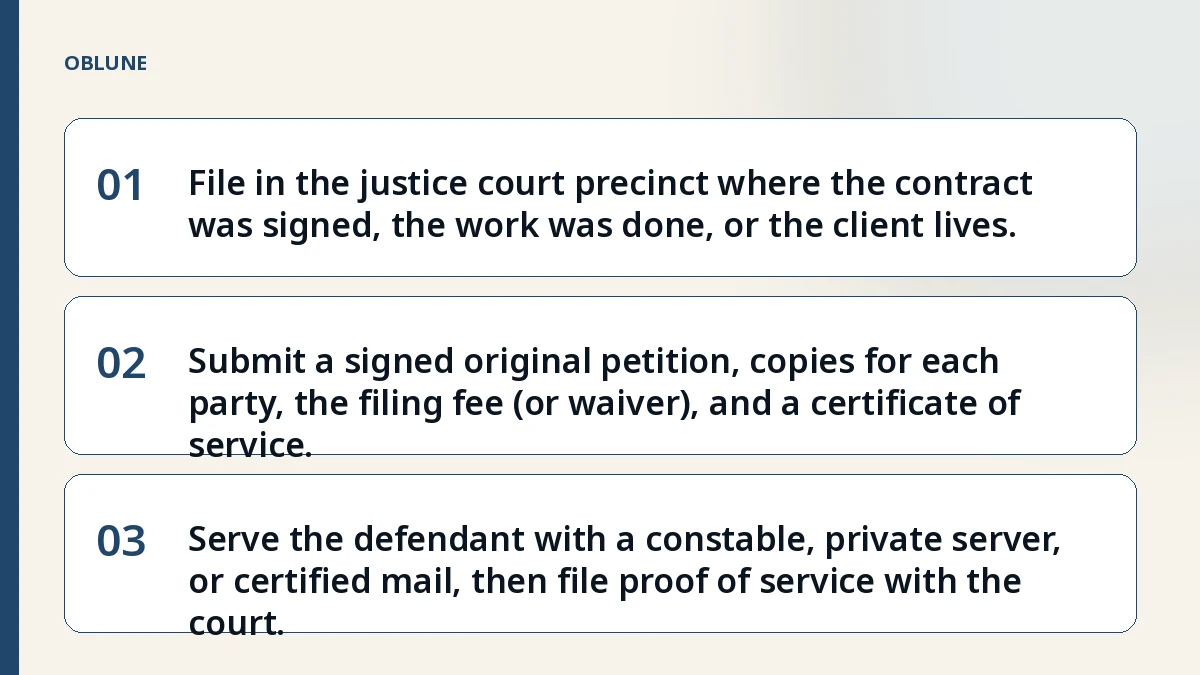
- 01File in the justice court precinct where the contract was signed, the work was done, or the client lives.
- 02Submit a signed original petition, copies for each party, the filing fee (or waiver), and a certificate of service.
- 03Serve the defendant with a constable, private server, or certified mail, then file proof of service with the court.
When a freelance invoice goes unpaid
Last month a graphic designer in Austin sent an invoice for freelance work to a small business client, but the client never paid. The designer now needs a court order to collect the money owed.
Choose the right court and precinct
Texas justice courts hear claims up to $20,000, so most unpaid invoices fit here. You must file in the precinct where the contract was signed, the work was performed, or the defendant lives. Filing in the wrong precinct is a common rejection reason.
Gather the documents you need
Before you sit down at the clerk’s window, assemble everything the court expects. The table below lists the core items and why each matters.
| Document | Why it’s required |
|---|---|
| Signed original petition with numbered paragraphs | Establishes the claim and satisfies Rule 45 (pleading form) |
| One copy for each respondent plus one for the court file | Needed for service of process |
| Filing fee or a completed Statement of Inability to Afford Payment of Court Costs | Rule 145 governs fee waivers |
| Caption with court name, county, precinct, and full names and street addresses of both parties | Allows the clerk to issue citation |
| Signature in ink with printed name, address, and phone beneath | Rule 57 requires a wet‑ink signature |
| Certificate of service for any filing after the petition | Rule 21a mandates proof of delivery |
| Attachments numbered continuously from 1 with an index page | Prevents rejection for mismatched exhibits |
| Copy of the contract or invoice pages you rely on | Shows the basis of the debt |
Fill out the petition – step‑by‑step
- Write the caption exactly as the court requires (court name, county, precinct, cause number left blank).
- In the Statement of Facts, describe the agreement, the work performed, the invoice date, amount, and the non‑payment.
- State the relief you seek: the invoice amount plus court costs.
- Attach the invoice, any email confirmations, and the contract excerpt as Attachments 1‑3.
- Sign the petition in ink, print your name, address, and phone number below the signature line.
- Complete a Certificate of Service showing you mailed or hand‑delivered a copy to the defendant today.
- Prepare the filing fee payment (cash, money order, or credit card) or the fee‑waiver affidavit.
File the petition and pay the fee
Take the original petition, all copies, and the fee (or waiver) to the justice court clerk during business hours. The clerk will stamp the cause number, keep the original, and return the copies. Rules change, so verify the current filing fee schedule on the court’s website or by calling the clerk.
Serve the respondent
After filing, you must deliver a copy of the stamped petition and citation to the defendant. A constable, private process server, or certified mail with return receipt can perform service of process. File the completed Certificate of Service with the court within the time the clerk specifies.
What happens after filing
The court sets a hearing date, usually within 30‑45 days. Bring all originals and a second set of copies to the hearing. The judge will review the petition, attachments, and any evidence the defendant presents. If the defendant does not appear, you may request a default judgment under Rule 502.6. For more on evidence preparation, see the Small Claims Court Evidence Submission guide.
References: Texas Rules of Civil Procedure, Rule 45 (Pleading form) – https://www.txcourts.gov/media/1453507/trcp.pdf; Rule 57 (Signing of pleadings) – https://www.txcourts.gov/media/1453507/trcp.pdf; Rule 145 (Affidavit of inability to pay court costs) – https://www.txcourts.gov/media/1453507/trcp.pdf
Related reading
Check the filing format before you file
See what the court in your region asks for, and what a prepared package contains.
Common questions
Can I file an unpaid freelance invoice in justice court if the amount is over $20,000?
No. Justice courts are limited to claims of $20,000 or less. Larger amounts must go to a county court at law.
What if I cannot afford the filing fee?
You can file a Statement of Inability to Afford Payment of Court Costs (Rule 145) instead of paying the fee.
Do I need a lawyer to file the petition?
Self‑representation is allowed in Texas justice courts; you can file and appear on your own.
How long do I have to serve the defendant after filing?
The clerk will give you a deadline, typically 30 days. Check the court’s current instructions for the exact period.
Official sources
General information about court filing formalities. Not legal advice, and no attorney-client relationship is created. Filing rules change; check the court's current published instructions before you file.