
















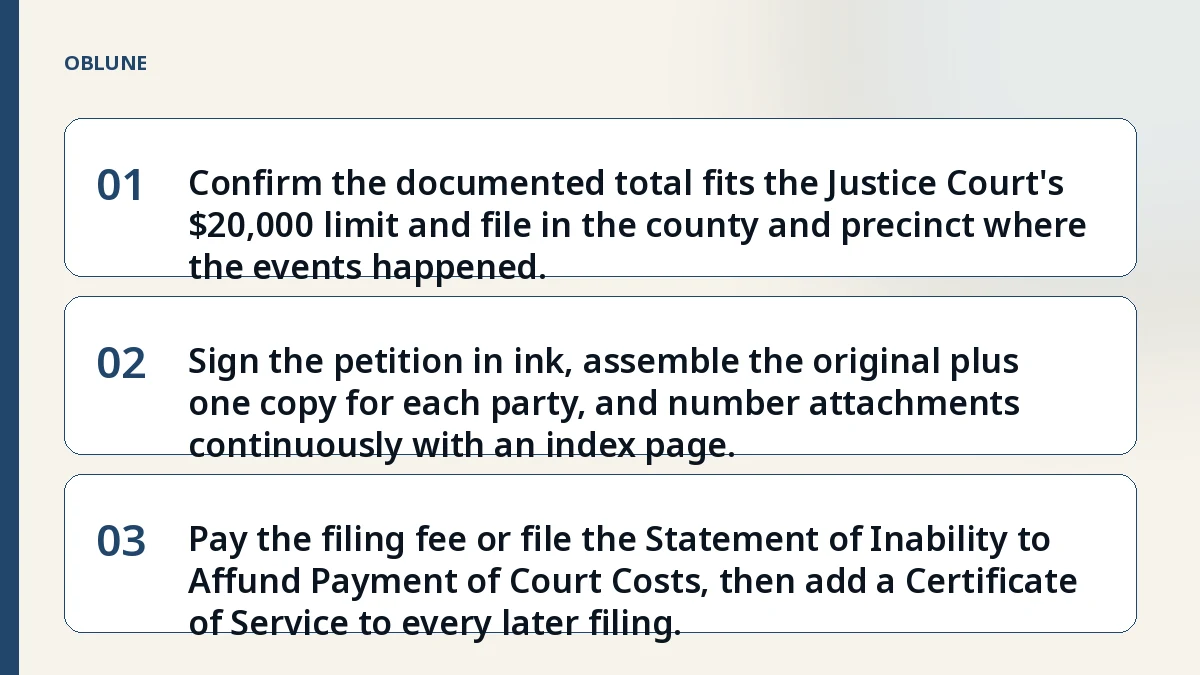
- 01Confirm the documented total fits the Justice Court's $20,000 limit and file in the county and precinct where the events happened.
- 02Sign the petition in ink, assemble the original plus one copy for each party, and number attachments continuously with an index page.
- 03Pay the filing fee or file the Statement of Inability to Affund Payment of Court Costs, then add a Certificate of Service to every later filing.
A Houston homeowner paid a $3,500 deposit for a kitchen floor, watched the crew walk away after two days, and then found a stack of unanswered text messages. That is the moment you learn how to sue a contractor in small claims court in Texas. The Justice Court handles claims up to $20,000, excluding interest and costs, and self-representation is allowed. Rules change, so the court's current instructions control what you file and how.
Start with the money and the paperwork
Before you write anything, add up what you can document: the deposit, payments already made, and any extra cost you had to pay to finish the job. Keep the contract, change orders, invoices, receipts, and every text or email thread. If the claim rests on a written lease or contract, attach a copy of the pages you are relying on.
Make a quick list of facts in date order: what you agreed to, what was paid, what was delivered, and what remains unfinished. That list becomes your Statement of Facts. It keeps the petition short and gives you a single place to check dates and dollar amounts.
Pick the Justice Court and the right precinct
The court sits in the county and precinct where the events happened or where the defendant can be found. File in the wrong county or precinct and the clerk will send the case back. Check the court's current instructions before you pay the filing fee.
The Justice Court civil jurisdiction generally extends to claims of $20,000 or less, excluding interest and costs. If your documented total runs higher, a County Court at Law may be the right track, and jurisdictional limits vary by county and by the basis of the claim. Confirm the county's own limit before filing.
The filing sequence, in order
Work through these steps in this order so the paperwork stays consistent:
- Fill the caption. Write the court name, county and precinct, your full name and street address, and the defendant's full name and street address.
- Write numbered paragraphs. State the agreement, the payments, the work performed, and the balance you are claiming.
- Sign in ink. Put your signature on the signature line, then print your name, address and telephone number beneath it. An unsigned pleading is struck.
- Assemble the copies. File one signed original petition on paper, one copy for the defendant, and one copy for the court file.
- Number the attachments. Number them continuously from 1 and add an index page listing each attachment by number and name. Attach the contract pages you rely on.
- Pay the filing fee. The court sets the fee; check the current schedule. If you cannot pay, file a completed Statement of Inability to Afford Payment of Court Costs instead.
- Take the next filing seriously. Everything filed after the petition needs a Certificate of Service stating the date and manner of delivering a copy to the other side.
Pack the documents the clerk will look for
Bring paper copies and keep a digital backup. A simple folder structure saves time at the counter.
| Item | Why it matters |
|---|---|
| Contract or written estimate, pages you rely on | Shows the agreed scope and price |
| Receipts and bank or payment-app records | Ties each dollar to a date |
| Texts, emails, voicemails | Shows notices, promises, and dates |
| Photos before, during, and after | Shows unfinished or damaged work |
| Written estimate to finish the job | Supports the amount you are claiming |
| Certificate of Service | Needed on anything filed after the petition |
Watch the six common rejection reasons
These come up often at the counter, and each one stops the case:
- The petition is not signed. The signature block must be completed in ink before filing.
- No Certificate of Service on a later document.
- Attachments are not numbered continuously, or the index does not match the pages attached.
- The caption omits a party's address or the court name, so the clerk cannot issue service. | The stated amount exceeds the justice court limit.
- Filing in the wrong county or precinct for the place where the events happened.
Service of process and the next filing
After the clerk accepts the petition, service of process follows the court's current instructions. Keep a copy of everything you hand over. For any later filing, write the Certificate of Service with the date and the manner of delivery, then sign it.
If the defendant does not appear, ask the clerk how the court handles that step. Rule 502.6 covers default judgment in Justice Court, and the court's own instructions control the procedure. Rules change, so confirm the current steps before you file anything new.
Before you pay the filing fee
Call or check the Justice Court's current instructions for the filing fee, accepted payment methods, and whether the court prefers an additional copy. Ask how service of process is arranged and what address the clerk needs for the defendant. If the cost is out of reach, ask about the Statement of Inability to Affund Payment of Court Costs, filed under Rule 145.
For the shape of the petition itself, Rule 45 sets pleading form, Rule 57 covers signing, and Rule 79 covers the caption. The texas court page for this jurisdiction lists the local Justice Court details you need before you drive over.
Keep the case moving
Put the Cause No. on every later filing, date each paper, and file one extra copy for your records. Our guided preparation flow walks through the same sequence in order, and the article index collects the other Texas filing checklists.
A contractor dispute is a paper case as much as a workmanship case. Gather the documents, file in the right precinct, sign in ink, and let the clerk confirm the rest against the court's current instructions.
Check the filing format before you file
See what the court in your region asks for, and what a prepared package contains.
Common questions
How much does it cost to sue a contractor in Texas small claims court?
The court sets the filing fee, so check the current schedule before you go. If you cannot pay, you can file a completed Statement of Inability to Affund Payment of Court Costs instead.
Where do I file a small claims case against a contractor in Texas?
File in the Justice Court for the county and precinct where the events happened or where the defendant can be found. Filing in the wrong county or precinct will send the case back.
What papers do I need to bring to the Justice Court?
Bring one signed original petition on paper, one copy for the defendant, one copy for the court file, your contract pages, and numbered attachments with an index page. Bring receipts, texts, and photos as backup.
What happens after I file against a contractor?
The clerk accepts the papers and service of process follows the court's current instructions. Keep a copy of everything, add a Certificate of Service to any later filing, and put the Cause No. on each new paper.
Official sources
General information about court filing formalities. Not legal advice, and no attorney-client relationship is created. Filing rules change; check the court's current published instructions before you file.