
















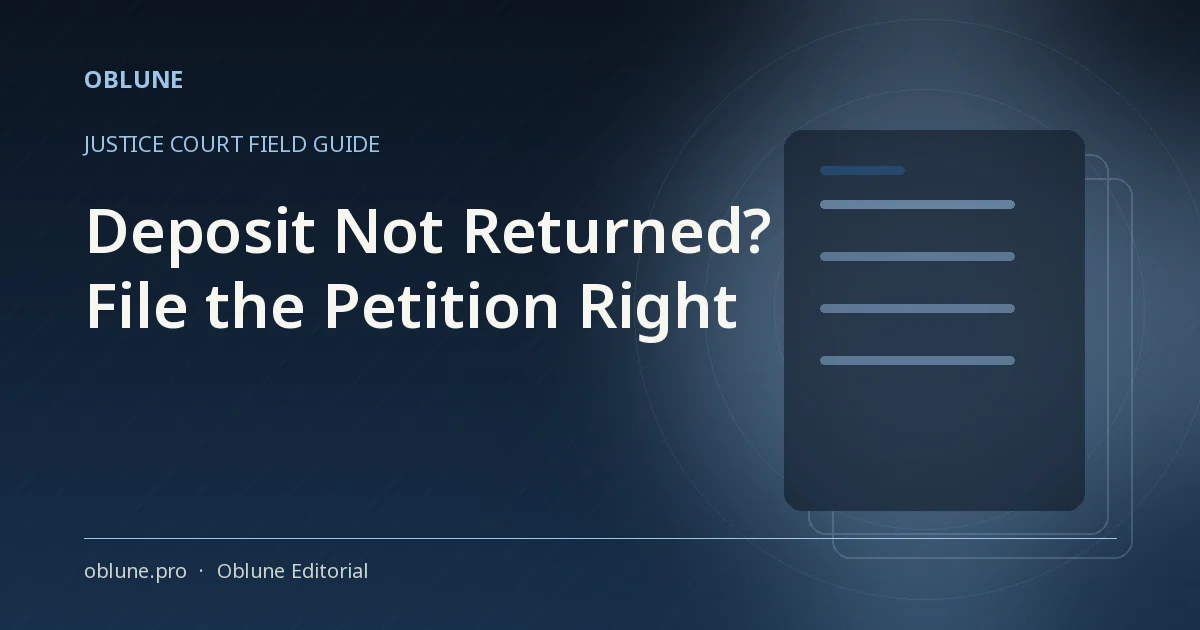
- 01Fill every caption line with street addresses so the constable can serve the landlord.
- 02Number attachments 1 through N and include a matching index page or the clerk will return the packet.
- 03Bring the filing fee or a signed inability-to-pay affidavit; the clerk will not issue citation without one.
The move-out that didn't end at the door
Maria packed her apartment near White Rock Lake, scrubbed the tub, and handed the keys to the property manager on a Tuesday. Thirty days later the mailbox held only a water bill. No check, no itemized letter, no text. She looked up "security deposit not returned" on her phone and found the justice court petition. The form looked short, but every blank had a purpose.
Why the justice court form looks the way it does
The petition is not a letter to the judge. It is a set of instructions for the clerk, the constable, and the respondent. Each field triggers a step: service of process, docketing, the hearing calendar. Miss one and the clerk hands the stack back. The Texas Rules of Civil Procedure, Rule 45 and Rule 79, set the layout so every justice court in the state reads the same sheet the same way.
The caption and parties — what goes in each line
The top block asks for the court name, county, and precinct. Write "Justice Court, Precinct 3, Dallas County" if that is where the lease property sits. Below that, your full legal name and street address go on the plaintiff line. The defendant line needs the landlord's or property company's full legal name and a street address where a constable can find them. A P.O. box alone will stall service of process. The cause number stays blank; the clerk stamps it when the filing fee is taken.
Statement of facts — the story the court reads first
This section is not a narrative essay. Number each paragraph. Paragraph one: the lease dates and the address. Paragraph two: the deposit amount and the date you surrendered possession. Paragraph three: the date you gave a forwarding address in writing. Paragraph four: the 30-day deadline passed with no check and no itemized deduction list. Paragraph five: the amount you are claiming, including the statutory multiplier if the landlord acted in bad faith. Keep each paragraph to one fact. The judge scans this before the hearing.
Attachments and the index — numbered exhibits the clerk expects
Every document you rely on becomes an attachment numbered continuously from 1. The first page of the packet is an index that lists each attachment by number and name. Typical exhibits for a deposit case:
- Attachment 1: the lease pages showing the deposit amount and the property address
- Attachment 2: your move-out inspection photos or video log
- Attachment 3: the certified-mail receipt proving you gave a forwarding address
- Attachment 4: the 30-day demand letter you sent (keep a copy)
- Attachment 5: any text or email where the landlord acknowledged the deposit
If the index says "Attachment 3 — Photos" but the third stapled page is a lease, the clerk will return the packet. The Texas Rules of Civil Procedure, Rule 21a, also require a certificate of service on everything filed after the petition, stating the date and manner you delivered a copy to the landlord.
Filing fee and inability to pay — what to bring or file instead
The court sets the fee; it varies by county and precinct. Call ahead or check the court's website for the current schedule. If you cannot pay, complete a Statement of Inability to Afford Payment of Court Costs under Texas Rules of Civil Procedure, Rule 145. File the signed original with the petition. The clerk will rule on it before issuing citation. Do not leave the fee line blank and do not write "will pay later."
Service of process — getting the citation to the landlord
After the clerk accepts the petition, the court issues a citation. You must arrange for a constable or private process server to hand it to the defendant. The citation tells the respondent the answer date and the hearing location. If the landlord is a company, serve the registered agent listed with the Texas Secretary of State. A return of service signed by the server goes back into the court file. Without it, the judge cannot enter a default judgment under Rule 502.6.
Checklist before you walk in
- One signed original petition with numbered paragraphs and completed caption.
- One copy for each respondent plus one for the court file.
- Filing fee in cash, money order, or the signed inability-to-pay affidavit.
- Attachments numbered 1 through N with a matching index page.
- Lease pages you are relying on, highlighted but not altered.
- Certificate of service on the petition copy you will serve (date and manner blank until service happens).
- Your government-issued ID in case the clerk asks.
Common rejection reasons — a quick-reference table
| Reason the clerk returns the packet | What to fix before refiling |
|---|---|
| Petition not signed in ink | Sign on the signature line; print name, address, phone beneath |
| No certificate of service on post-petition filings | Add date and manner of delivery for each document |
| Attachments not numbered continuously | Re-index so the list matches the stapled order |
| Caption missing court name or party address | Fill every caption line; use street address for service |
| Claim exceeds $20,000 limit | File in county court at law instead |
| Wrong county or precinct for the lease property | File where the rental unit is located |
Rules change and the court's current instructions control. Confirm the filing fee, the precinct map, and the service options with the clerk before you leave home. The guided preparation flow at /en/us-tx/prepare/ walks through each field with Texas-specific prompts. For the full court directory see /en/us-tx/. If you need a printable claim package for a deposit dispute, the article at /en/articles/security-deposit-30-days-claim-package/ shows a completed example. Procedural guides live at /en/guides/ and the service overview is at /en/how-it-works/.
Check the filing format before you file
See what the court in your region asks for, and what a prepared package contains.
Common questions
Do I need a lawyer to file a security deposit case in justice court?
No. Self-representation is allowed in Texas justice court for claims up to $20,000. You file the petition yourself and present your evidence at the hearing.
What if the landlord lives in another county?
You still file in the county and precinct where the rental property is located. The constable in that precinct handles service, even if the defendant is served elsewhere.
Can I include the statutory three-times penalty in the amount I claim?
Yes, if you allege the landlord acted in bad faith by withholding the deposit without a valid reason. State the base deposit and the multiplied amount in separate numbered paragraphs.
How long do I have to file after the 30-day deadline passes?
The statute of limitations for a security deposit claim is generally four years in Texas, but filing sooner preserves evidence and witness memory. Check the current limitations period with the clerk.
Official sources
General information about court filing formalities. Not legal advice, and no attorney-client relationship is created. Filing rules change; check the court's current published instructions before you file.