

















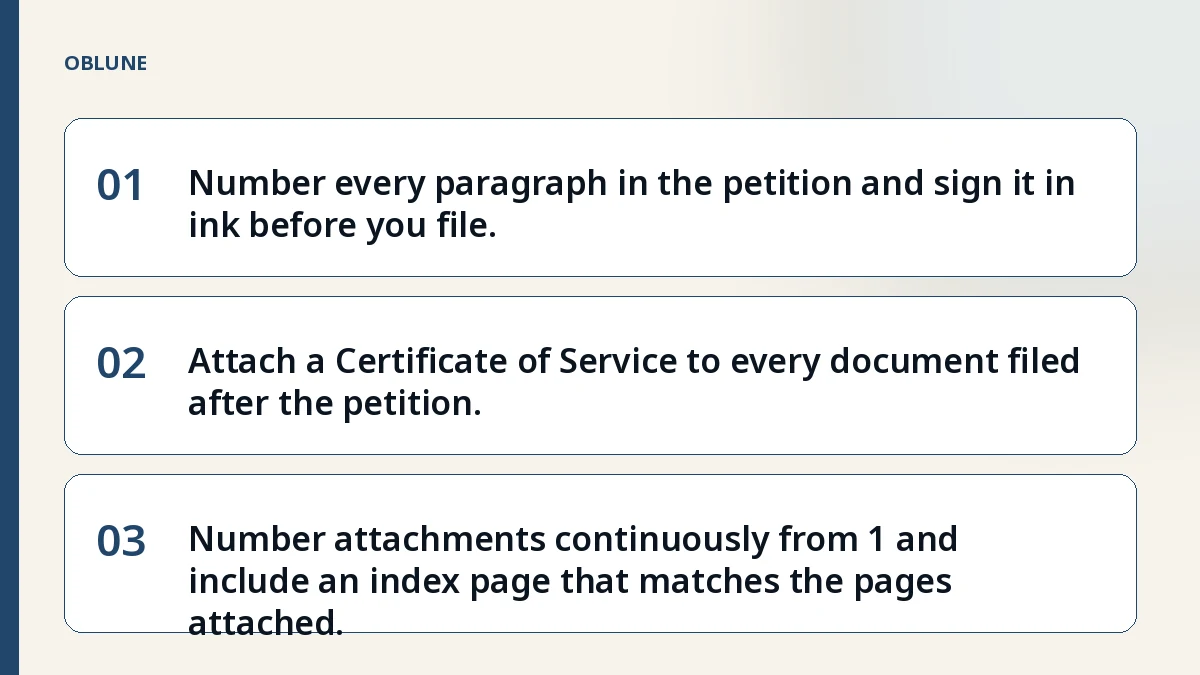
- 01Number every paragraph in the petition and sign it in ink before you file.
- 02Attach a Certificate of Service to every document filed after the petition.
- 03Number attachments continuously from 1 and include an index page that matches the pages attached.
Start With the Petition the Clerk Will Actually Accept
Your contractor cashed the deposit check in September, promised to start the bathroom remodel after the first cold snap, and then stopped answering texts. Now you are standing in line at the precinct office with a folder of screenshots and no idea what the clerk needs to see. The phrase contractor deposit law california gets typed into search bars by people looking for rules, but if you live in Texas, your claim runs through the Justice Court, and the package you hand over matters more than the label on the search.
A complete claim package is not one document. It is a stack that tells a story in order: who you are, who took the money, what happened, what you want, and what proves it. The clerk checks the stack against a short list before the case ever reaches a judge. If a page is missing or unsigned, the filing can be struck or returned.
Rules change, and the court's current instructions control. Treat this as a map of the documents, not a substitute for what the clerk tells you at the window.
The Caption: Names, Addresses, and the Court
The caption sits at the top of the first page. It names the court, the county and precinct, the parties, and the Cause No. if one has been assigned. The Justice Court needs your full name and street address, and the Defendant's full name and street address. A post office box alone can stall service of process.
If the caption omits a party's address or the court name, the clerk cannot issue service. That is one of the most common rejection reasons, and it is also the easiest to fix before you file.
Write the parties exactly as they appear on the contract, the invoice, or the text messages. If the contractor used a business name, list the business and the person who signed, if you know both.
Numbered Paragraphs and the Statement of Facts
Texas Rules of Civil Procedure, Rule 45 covers pleading form. The petition should use numbered paragraphs, and each paragraph should carry one fact or one request. Do not bury three arguments in a single block of text.
Your Statement of Facts is the spine of the petition. It should read in plain order: you hired the contractor, you paid a deposit, the work stopped, you asked for a refund, the contractor did not pay. Keep dates and dollar amounts specific. If you paid by Venmo, Zelle, or a check, say which one and when.
A short petition with clean numbered paragraphs is easier for the judge to follow than a long letter. The goal is not to sound like a lawyer. The goal is to be clear.
Sign It in Ink, Then Serve It
Rule 57 requires a signature on pleadings. An unsigned pleading is struck, and the signature block must be completed in ink before filing. Beneath the signature line, print your name, address, and telephone number.
After the petition, every document you file needs a Certificate of Service. Rule 21a governs service of notices and documents. The certificate states the date and the manner you delivered a copy to the other side. If you mailed it, say mailed. If you hand-delivered it, say hand-delivered.
No certificate of service is a common rejection reason. The clerk is not asking you to prove the Defendant received it. The clerk is asking you to state when and how you sent it.
The Filing Fee or the Inability Statement
Bring the filing fee, or bring a completed Statement of Inability to Afford Payment of Court Costs if you cannot pay it. Rule 145 covers the affidavit of inability to pay court costs. The court sets the fee, so check the current schedule at the precinct office or the county website before you go.
Do not guess the amount. If you are unsure, call the Justice Court clerk and ask what the current filing fee is for your type of claim. The clerk can also tell you whether the Statement of Inability form is accepted in that precinct.
If you pay by check, make it out as the clerk directs. Keep your receipt. It belongs in your own copy of the file.
Attachments: Number Them From 1
Attachments are the proof pages. Number them continuously from Attachment 1, and put an index page at the front listing each attachment by number and name. If the claim rests on a written lease or contract, include a copy of the pages you are relying on.
A useful attachment set for a contractor deposit dispute often looks like this:
- Attachment 1: The signed contract or estimate, if there is one.
- Attachment 2: Proof of payment, such as a bank statement, check image, or payment app receipt.
- Attachment 3: Text messages or emails where you asked for the work or the refund.
- Attachment 4: Photos of the unfinished work, if you have them.
- Attachment 5: A written demand letter or refund request, if you sent one.
Attachments are returned when the index does not match the pages attached. Count the pages twice. If you have ten pages, the index should list ten pages.
A Checklist for the Day You File
Use this sequence at the counter or before you mail the package:
- Confirm the court name, county, and precinct on the caption.
- Confirm your full name and street address, and the Defendant's full name and street address.
- Number every paragraph in the petition.
- Sign the petition in ink and print your name, address, and telephone number beneath the signature.
- Attach the Certificate of Service for anything filed after the petition.
- Number every attachment continuously from 1 and include the index page.
- Include the filing fee or the completed Statement of Inability to Afford Payment of Court Costs.
- Make one copy of the petition for each Defendant, plus one copy for the court file.
If you are filing in the wrong county or precinct for the place where the events happened, the case can be rejected. Ask the clerk which precinct covers the address where the contractor took the deposit or where the work was supposed to happen.
What the Justice Court Limit Means for Your Claim
Justice court civil jurisdiction generally extends to claims of $20,000 or less, excluding interest and costs. If your stated amount exceeds the justice court limit, the claim is filed in the wrong court. County Court at Law has a higher limit, but the jurisdictional limits vary by county and by the basis of the claim, so check the county's own limit before filing.
If your deposit was $3,500 and you want it back, the Justice Court is likely the right starting point. If your claim is larger, ask the clerk whether the County Court at Law is the correct court for your county.
Self-representation is allowed in both courts. You do not need a lawyer to file, but you do need a package the clerk can accept.
Keep Your Own Copy Clean
Before you hand anything over, make a complete copy for yourself. Keep the index page, the numbered attachments, and the signed petition together. If the clerk asks for a correction, you will know exactly which page to fix.
For a guided walk-through of the preparation steps, see the guided preparation flow. If you are still deciding which court fits, start with the court page for this jurisdiction. For more on how evidence is handled after filing, read Small Claims Court Evidence Submission: What the Justice Court Requires.
A deposit dispute is frustrating, but the filing itself is a paperwork problem. Solve the paperwork first, and the rest of the case has a chance to be heard.
Check the filing format before you file
See what the court in your region asks for, and what a prepared package contains.
Common questions
Can I file a contractor deposit claim in Texas Justice Court without a lawyer?
Yes. Self-representation is allowed in Justice Court. You will need to prepare the petition, sign it, serve the Defendant, and bring the filing fee or a Statement of Inability to Afford Payment of Court Costs.
What happens if I forget the Certificate of Service?
The clerk may reject the filing or return it for correction. Every document filed after the petition must state when and how a copy went to the other side.
How do I know if my claim belongs in Justice Court or County Court at Law?
Justice court civil jurisdiction generally extends to claims of $20,000 or less, excluding interest and costs. If your claim is larger, check the county's own limit for County Court at Law before filing.
Do I need to attach the whole contract or just some pages?
If the claim rests on a written lease or contract, include a copy of the pages you are relying on. Number them as attachments and list them in the index page.
Official sources
General information about court filing formalities. Not legal advice, and no attorney-client relationship is created. Filing rules change; check the court's current published instructions before you file.