
















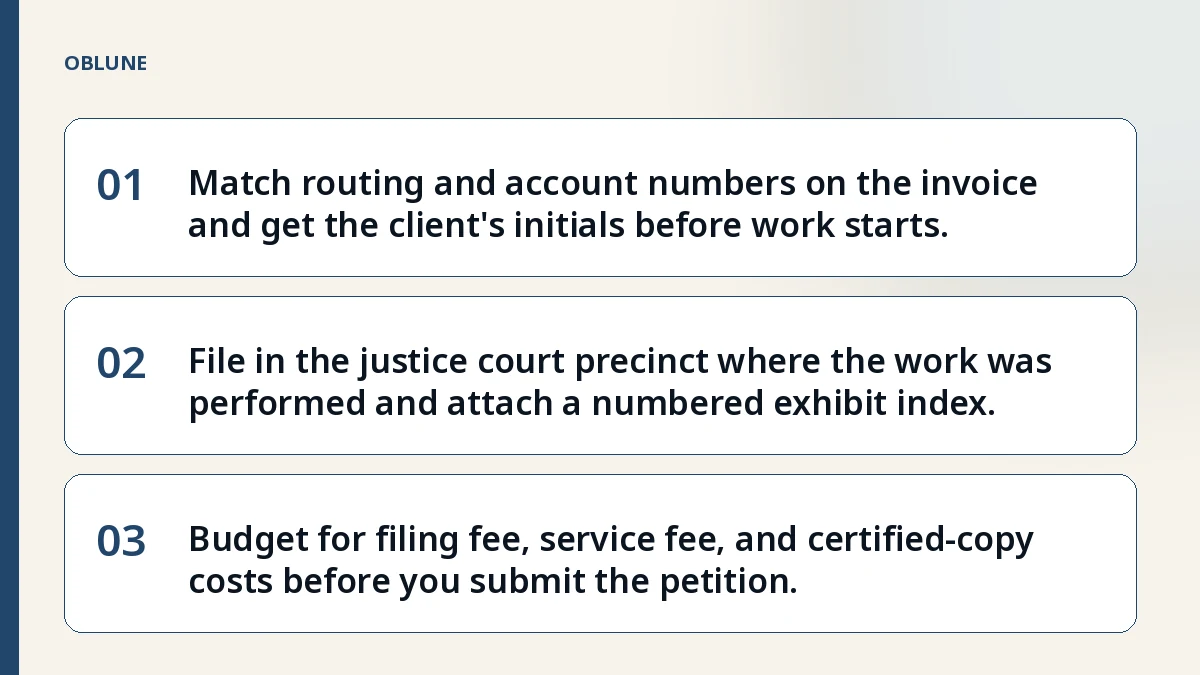
- 01Match routing and account numbers on the invoice and get the client's initials before work starts.
- 02File in the justice court precinct where the work was performed and attach a numbered exhibit index.
- 03Budget for filing fee, service fee, and certified-copy costs before you submit the petition.
The deposit that never arrived
A Fort Worth framing contractor finishes a room addition in July. The homeowner says the money was sent via direct deposit on Friday. By Tuesday the contractor's credit union still shows nothing. The homeowner sends a screenshot of a transfer confirmation, but the routing number on the screen is one digit off from the account the contractor gave them. The contractor has no signed change-order for the new account, just a text thread. That gap is where a justice court claim starts.
Why direct deposit for contractors creates evidence gaps
Direct deposit for contractors sounds faster than checks, but it leaves a thinner paper trail. A cancelled check shows the payee, the amount, and the date in one image. A bank push notification shows only that the sender's bank accepted the instruction. If the routing or account number is wrong, the money can sit in a clearing house for days or bounce back to the sender without either party getting a clear notice. Texas justice courts expect you to prove the debt and the failure to pay with documents that speak for themselves.
Checklist: Set up so you can prove payment later
- Open a business account in your exact legal name or DBA name on file with the county.
- Write the routing and account numbers on your invoice and have the client initial that line.
- Save a PDF of the blank direct-deposit authorization form you give each client.
- Keep a screenshot of your bank's "account details" page showing the same numbers.
- When a payment is late, request a trace number from the sender's bank and save that email.
- Do not change accounts mid-project without a signed written amendment.
Documents the court expects to see
| Document | Why it matters | Common mistake |
|---|---|---|
| Signed invoice with initialed banking line | Proves the agreed amount and the exact account | Client initials missing or numbers transposed |
| Bank statement showing no deposit | Shows non-receipt on your side | Statement cut off before the expected date |
| Sender's bank trace confirmation | Proves the money left their account | Screenshot without trace number or date |
| Text or email admitting the error | Admission by the other party | Informal chat deleted before saving |
| Certificate of Service for demand letter | Required before filing | Filed without proof the other side got it |
Filing in justice court when the money does not show
If the amount is $20,000 or less, you file in the Justice Court for the precinct where the work was done or where the defendant lives. The petition needs one signed original with numbered paragraphs, a copy for each respondent, and the filing fee or a Statement of Inability to Afford Payment of Court Costs. The clerk will not issue service of process if the caption omits an address or the stated amount exceeds the court's limit. Attachments must be numbered continuously from 1 with an index page. Rules change, so check the court's current instructions before you file.
Real costs nobody itemizes for you
The filing fee varies by county and precinct; the court sets the fee and it can change each budget cycle. Service by a constable or private process server adds another charge that depends on mileage and attempts. If you need a certified copy of the judgment for an abstract of judgment, that is a separate per-page fee. Lost wages or travel for the hearing are not recoverable as court costs. Build a small buffer into your claim budget for these items.
Serving the respondent the right way
After filing, you must arrange service of process. A constable in the respondent's county can serve for a set fee, or you can hire a private process server approved by the court. You cannot serve the papers yourself. Once service is complete, the server files a return with the court. That return starts the clock for the respondent's answer. If the address is wrong, the server will note it and you will have to pay again for a new address. Verify the respondent's current address before you pay for service.
What happens at the hearing
Justice court hearings are informal but on the record. Bring three copies of every document: one for you, one for the judge, one for the other side. The judge will ask each party to state their case and may ask questions. You cannot rely on a verbal agreement to change the deposit account; the judge will look for a signed writing. If the respondent does not appear, you still have to present evidence of the debt and the failed deposit before a default judgment is entered under Rule 502.6.
After judgment: getting paid
A judgment is not a check. If the respondent does not pay, you can request an abstract of judgment to place a lien on real property, or ask for a writ of execution to seize non-exempt assets. Both require additional forms and fees. The court clerk can give you the forms, but cannot tell you which asset to target. Many contractors find that a certified letter attaching the abstract prompts payment without further court action.
Key reminders before you file
- Direct deposit for contractors works only when the numbers match and you keep the proof.
- The justice court packet rejects unsigned petitions, missing certificates of service, and unnumbered attachments.
- The clerk or the court's current instructions control every fee and deadline; verify them the week you file.
Related reading
Check the filing format before you file
See what the court in your region asks for, and what a prepared package contains.
Common questions
Can I sue in justice court if the direct deposit was sent to the wrong account?
Yes, if the amount is $20,000 or less. You must prove the agreed account numbers and show the deposit did not reach that account.
Do I need a lawyer for a direct deposit dispute in justice court?
No. Self-representation is allowed and common in justice court. The judge will expect organized documents, not legal citations.
What if the client says they sent it but my bank has no record?
Ask the client's bank for a trace number and a written confirmation. Save that document as an exhibit.
How long after filing does the hearing get set?
The court sets the docket. Check with the clerk when you file; some precincts schedule within weeks, others take longer.
Official sources
General information about court filing formalities. Not legal advice, and no attorney-client relationship is created. Filing rules change; check the court's current published instructions before you file.