
















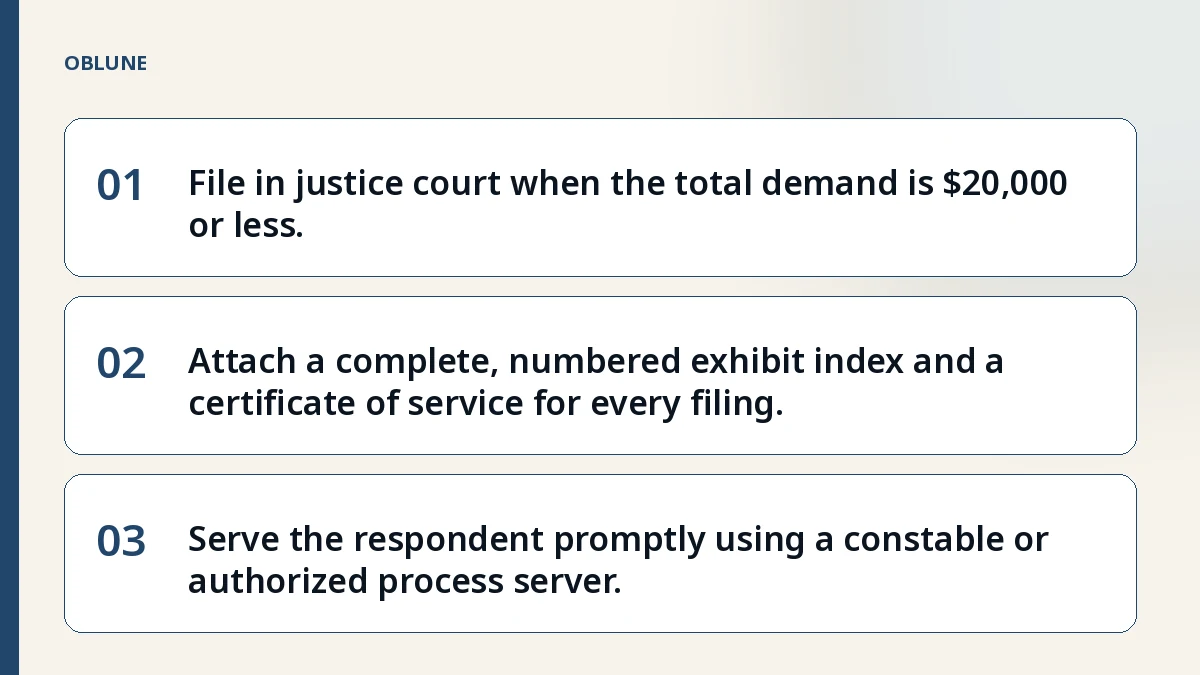
- 01File in justice court when the total demand is $20,000 or less.
- 02Attach a complete, numbered exhibit index and a certificate of service for every filing.
- 03Serve the respondent promptly using a constable or authorized process server.
When Your Insurer Refuses to Pay
Maria's homeowner policy denied coverage for storm damage to her roof in Dallas, leaving her with a $12,000 repair bill. She decided to sue insurance company in small claims court because the amount falls under the justice court limit. The claimant files as Plaintiff and the insurer becomes the respondent. A clear statement_of_facts and supporting documents are the foundation of any case.
Two Court Tracks in Texas
Texas offers two civil tracks that can hear an insurance dispute under $20,000. The justice court handles claims up to $20,000 and allows self‑representation. The county court at law can hear claims up to $250,000, but its jurisdictional limit varies by county. Rules change, so the court's current instructions control which track is proper for your case. Texas Rules of Civil Procedure, Rule 45 outlines the pleading form for both courts.
Choosing the Right Track for Your Claim
If your total demand — including any attorney fees you are not claiming — stays at or below $20,000, the justice court is the simplest venue. Choose the county court at law only when the amount exceeds that cap or when a local rule requires it. Verify the precise limit with the clerk before you file; the clerk or the court's current instructions control the final determination.
Documents You Must Attach
| Document | Description |
|---|---|
| Signed petition | One original with numbered paragraphs, caption completed, and ink signature. |
| Copies for each respondent | One copy per defendant plus one for the court file. |
| Filing fee or Statement of Inability | Pay the filing fee or submit a completed Statement of Inability to Afford Payment of Court Costs. |
| Certificate of service | Required for every filing after the petition, stating date and manner of delivery. |
| Attachments with index | Numbered continuously from 1, with an index page listing each attachment by number and name. |
| Lease or contract pages | If the claim rests on a written policy provision, attach the relevant pages. |
Step‑by‑Step Filing Checklist
- Draft the petition with a proper caption (court name, county, precinct, parties' full names and addresses).
- Attach the statement_of_facts and all evidence listed in the table above.
- Sign the petition in ink; print your name, address, and telephone beneath the signature line.
- Prepare the required number of copies and a certificate_of_service for each.
- Pay the filing fee or file the Statement of Inability; the court sets the fee.
- Submit the packet to the clerk and obtain a cause_number.
- Arrange service_of_process through a constable or private process server.
Common Filing Mistakes to Avoid
- Unsigned petition – an unsigned pleading is struck under Rule 57.
- Missing certificate_of_service – every post‑petition filing must include one per Rule 21a.
- Attachments not numbered continuously – exhibits are returned when the index does not match.
- Caption omits a party's address or court name – the clerk cannot issue service.
- Claim amount exceeds the justice court limit – the case is filed in the wrong court.
After You File: Service and Next Steps
Once the clerk issues a citation, you must serve the respondent within the time the court specifies. A constable can deliver the citation, or you may hire a private process server. After service, the respondent has a set period to answer; if they do not, you may request a default judgment under Rule 502.6. Keep copies of every filed document and track all deadlines on your calendar.
Related reading
Check the filing format before you file
See what the court in your region asks for, and what a prepared package contains.
Common questions
Can I sue my insurance company in justice court if the claim is $18,000?
Yes. Justice court handles claims up to $20,000, so an $18,000 dispute fits within its limit.
What happens if I forget to attach the certificate of service?
The clerk will reject the filing because every document after the petition must include a certificate of service under Rule 21a.
Do I need a lawyer to file in county court at law?
Self‑representation is allowed in both justice court and county court at law, but the county court may have additional local rules.
How do I know the exact filing fee for my county?
The court sets the fee; check the current fee schedule on the county clerk's website or call the clerk's office.
Official sources
General information about court filing formalities. Not legal advice, and no attorney-client relationship is created. Filing rules change; check the court's current published instructions before you file.