
















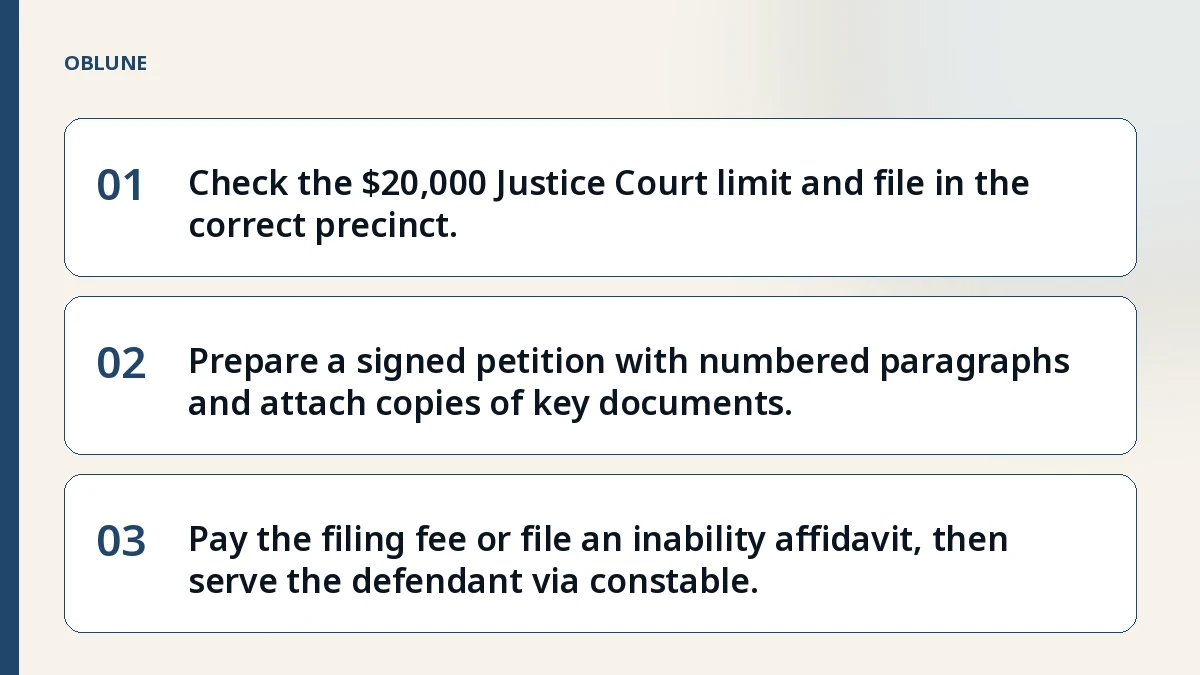
- 01Check the $20,000 Justice Court limit and file in the correct precinct.
- 02Prepare a signed petition with numbered paragraphs and attach copies of key documents.
- 03Pay the filing fee or file an inability affidavit, then serve the defendant via constable.
- 04Avoid common rejections: sign in ink, number attachments, and include a certificate of service for later filings.
Start with the Right Court and the Right Limit
You’re out $1,200 because a contractor took a deposit and never showed up, or a tenant skipped out owing rent. You’ve sent texts, maybe a demand letter, and now you’re ready to file in Justice Court. Good move—Texas Justice Courts handle small claims up to $20,000, not counting interest and court costs. That’s your “flash justice” route: quicker, simpler, and designed for people like you.
Before you draft anything, confirm your claim fits the limit. If your demand is $20,000 or less, Justice Court is likely your place. If it’s over that, you’d be in County Court at Law, which has higher limits but different rules. For most everyday disputes—unpaid invoices, security deposits, damaged goods—the Justice Court limit covers you.
Also, check you’re filing in the right county and precinct. Usually that’s where the defendant lives or where the events happened. If you file in the wrong place, the clerk may reject it, and you’ll lose time.
Know the Filing Sequence: What to Do First
Here’s the order you’ll act in, step by step. Follow it exactly to avoid delays.
- Gather your facts and evidence. Get the contract, lease, text messages, receipts, payment app screenshots (like Venmo or Zelle), and any emails. You don’t file evidence yet, but you’ll need to know what you have.
- Write your petition. This is your formal statement of claim. You must have a signed original, on paper, with numbered paragraphs and a completed caption. The caption includes the court name, county, precinct, both parties’ full names and street addresses, and a space for the Cause No. (you’ll leave that blank).
- Make copies. You need one copy for each defendant, plus one for the court file. So if you’re suing one person, bring the original plus two copies.
- Pay the filing fee or file an inability affidavit. The clerk sets the filing fee—check the current schedule. If you can’t afford it, you can file a Statement of Inability to Afford Payment of Court Costs (form available from the court).
- File at the Justice Court. Go to the clerk’s office in the right precinct. Submit your original and copies, pay the fee, and get a filing date.
- Serve the defendant. After filing, the court will arrange service of process—usually a constable or sheriff delivers the citation and a copy of your petition. You’ll pay a service fee, also set by the court.
That’s the core sequence. Missing a step—like not signing your petition—will get it rejected.
Write a Petition That Won’t Get Struck
The petition is the heart of your case. The court’s rules (Texas Rules of Civil Procedure, Rules 45, 57, and 79) spell out what it needs. Here’s a checklist:
- Caption: Court name, county, precinct, your full name and address, defendant’s full name and address.
- Statement of Facts: Numbered paragraphs telling what happened, when, and how much you’re owed.
- Prayer: What you want the court to do (e.g., award $1,200 plus court costs).
- Signature: Your ink signature on the signature line, with your printed name, address, and phone number below.
- If you have a written lease or contract: Attach copies of the pages you rely on, numbered as Attachment 1, 2, etc.
Common reasons petitions get rejected: no signature, missing addresses, or the amount exceeds the limit. Double-check every field before you go to the clerk.
What to Attach and How to Number It
If you have documents—contracts, invoices, photos—attach them to your petition. The court requires attachments numbered continuously from 1, with an index page listing each by number and name. For example:
- Attachment 1: Contract signed March 1, 2026
- Attachment 2: Invoice #1234, unpaid
- Attachment 3: Text messages about the deposit
If you don’t number them correctly, the clerk may return them. Keep a clean set for yourself.
After You File: Service and the Defendant’s Response
Once you file, the court issues a citation. The defendant must be served—that’s how they learn about the suit. Service is usually done by a constable or process server. The court will schedule a hearing date.
If the defendant doesn’t respond or show up, you might get a default judgment—but you still have to prove your case at a hearing. Don’t assume you win automatically.
Common Rejection Reasons and How to Avoid Them
Here are the top pitfalls that bounce filings back:
- No signature. The petition must be signed in ink. An unsigned pleading is struck.
- No certificate of service. For anything you file after the petition—like a motion—you must state when and how you delivered a copy to the other side.
- Attachments not numbered. Exhibits are returned if the index doesn’t match.
- Wrong court or precinct. Check the location where the events happened.
- Amount over the limit. If you claim more than $20,000, you’re in the wrong court.
What If You Can’t Afford the Filing Fee?
Texas allows you to file a Statement of Inability to Afford Payment of Court Costs (often called an “in forma pauperis” affidavit). This is a sworn statement that you can’t pay the filing fee. The clerk will provide the form. You can file it instead of paying, and the court will decide if you qualify. Check the current rules—they change, so ask the clerk.
Final Checks Before You File
- Confirm the Justice Court limit ($20,000) fits your claim.
- File in the correct county and precinct.
- Have your signed original and copies.
- Pay the fee or file the inability affidavit.
- Attach numbered documents with an index.
Remember: rules change, and each court may have its own local procedures. Always call the clerk or check the court’s website for current instructions. The clerk is there to help, not to trap you.
For a step-by-step walkthrough tailored to your case, see our guided preparation flow.
Related reading
Check the filing format before you file
See what the court in your region asks for, and what a prepared package contains.
Common questions
What is the small claims court limit in Texas?
In Justice Court, small claims cases are limited to $20,000 or less, not counting interest and court costs. If your claim is over that, you'd file in County Court at Law, but that court has different limits and rules.
How much does it cost to file in Texas Justice Court?
The filing fee is set by the court—it varies by county. You'll also pay a service fee for the constable to deliver the citation. If you can't afford these, you can file a Statement of Inability to Afford Payment of Court Costs.
What happens if my petition gets rejected?
The clerk will tell you why—like missing signature or wrong precinct. You can fix the issue and refile. To avoid rejection, double-check the caption, sign in ink, and ensure your amount is within the limit.
Do I need a lawyer for small claims court in Texas?
No, you can represent yourself. Justice Courts are designed for self-represented parties. Just follow the filing checklist and be prepared to present your evidence at the hearing.
Official sources
General information about court filing formalities. Not legal advice, and no attorney-client relationship is created. Filing rules change; check the court's current published instructions before you file.