
















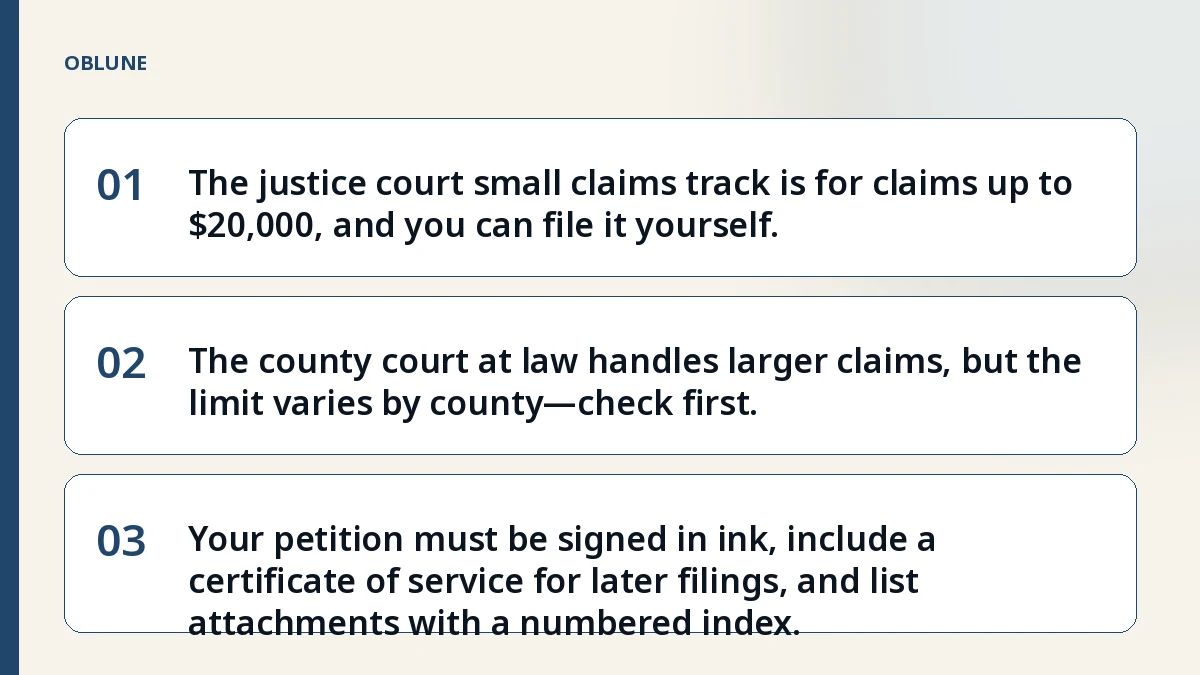
- 01The justice court small claims track is for claims up to $20,000, and you can file it yourself.
- 02The county court at law handles larger claims, but the limit varies by county—check first.
- 03Your petition must be signed in ink, include a certificate of service for later filings, and list attachments with a numbered index.
You have a claim. Which Texas court do you file in?
Let's say a contractor did work on your house and you never got paid. Or a neighbor's tree fell on your fence. Or a store sold you a defective appliance and won't refund you. The amount you're owed is under $20,000. Where do you go?
In Texas, the justice court small claims track is built for claims of $20,000 or less, excluding interest and costs. That's the court you'll likely use. If your claim is bigger—up to $250,000 in some counties—you might be in the county court at law. But the limits vary by county)Skip, so you need to check your county's own limit before you file.
This article compares the two tracks and shows you which facts belong in each filing. The goal is to help you prepare a clean petition that the clerk can process without delay.
The justice court small claims track: what it covers
The justice court small claims track is for money disputes, eviction defenses, insurance claim disputes, consumer problems, property damage, and unpaid invoices or services. The amount in dispute must be $20,000 or less, not counting interest and court costs.
You can represent yourself. The filing format is specific: file the original petition plus one copy for each defendant. Use letter-size paper, 1-inch margins, 12-point font, double-spaced, with numbered paragraphs. Include a caption with the parties' names and addresses, and sign at the end.
You also need a certificate of service for anything you file after the petition. That's a short statement saying when and how you delivered a copy to the other side.
The county court at law track: when the claim is larger
If your claim is more than $20,000, the justice court can't hear it. The county court at law is the next level, with a limit of $250,000 in many counties. But the limit varies by county and by the basis of the claim, so check your county's own limit first.
Self-representation is allowed there too. The filing format is similar but includes an exhibit index when you attach documents. The caption must follow the rules for district and county courts.
Even if your claim is under $20,000, there might be reasons to file in county court—for example, if the justice court in your county doesn't handle that type of claim. But for most small claims, the justice court is the right track.
Which facts go in each filing
Every filing needs the same core facts, but the way you present them differs slightly.
For the justice court small claims track, your petition must include:
- The court name, county, and precinct
- Your full name and street address
- The respondent's full name and street address
- A chronological statement of facts, with one numbered paragraph per event, in date order
- Communication between you and the other side: who, when, by what means, and the result
- A list of documents you have, with the name, date, and source
- What you are asking the court to order, stated factually
- An index of attachments, numbered continuously
- Your signature in ink, with your printed name, address, and phone number
- A certificate of service for anything filed after the petition
For the county court at law, the same facts are required, but you also need an exhibit index when you attach documents. The caption must follow the district and county court rules.
Why the court asks for these facts
The court needs these facts to know who is involved, where the events happened, and what you want. The caption must identify every party, including addresses, so the clerk can issue service of process. The constable or sheriff serves the respondent at a street address.
The statement of facts becomes the first paragraph of your petition. Dates drive the chronology and the filing deadlines. The amount you state decides which court can hear the claim. Amounts are printed exactly as you enter them.
Courts ask how a figure was reached, not why it is owed. So if you're claiming $5,000 for unpaid work, you need to show the dates of the work, the invoices, and the communication—not just say "they owe me."
Common rejection reasons and how to avoid them
The most common reason a filing is rejected is that the petition is not signed. An unsigned pleading is struck. Your signature block must be completed in ink before filing.
Another common issue is a missing certificate of service. Every document filed after the petition must state when and how a copy went to the other side.
Attachments that are not numbered continuously will be returned. If the index does not match the pages attached, the clerk may return your exhibits. Also, if the caption omits a party's address or the court name, the clerk cannot issue service.
If the stated amount exceeds the justice court limit, your claim is filed in the wrong court. And if you file in the wrong county or precinct for where the events happened, the clerk may reject it.
If you expect a default judgment, you need a military status affidavit for the respondent. Without it, the court will not sign a default.
What to do before you file
Before you file, gather your documents. If your claim rests on a written lease or contract, include a copy of the pages you rely on. If you can't pay the filing fee, you can file a Statement of Inability to Afford Payment of Court Costs.
Check that you are filing in the county and precinct where the events happened or where the respondent resides. That's a venue requirement, not a suggestion.
You can use the guided preparation flow on this site to build your petition step by step. It will ask you for the facts above and then produce a formatted petition you can print and sign.
Related reading
Check the filing format before you file
See what the court in your region asks for, and what a prepared package contains.
Common questions
What is the filing fee for justice court small claims?
The pack does not list a specific fee. The court sets the filing fee, and you can ask the clerk for the current schedule. If you can't pay, you may file a Statement of Inability to Afford Payment of Court Costs.
Do I need to file a copy for each defendant?
Yes. The pack says to file the original petition plus one copy per defendant. Also include one copy for the court file, as the pack notes.
What happens if I don't include a certificate of service?
Every document you file after the petition must have a certificate of service. Without it, the clerk may reject the filing. The certificate states the date and manner of delivering a copy to the other side.
Can I file in any justice court?
No. You must file in the county and precinct where the events happened or where the respondent resides. Filing in the wrong place will be rejected, so check that before you file.
Official sources
General information about court filing formalities. Not legal advice, and no attorney-client relationship is created. Filing rules change; check the court's current published instructions before you file.