
















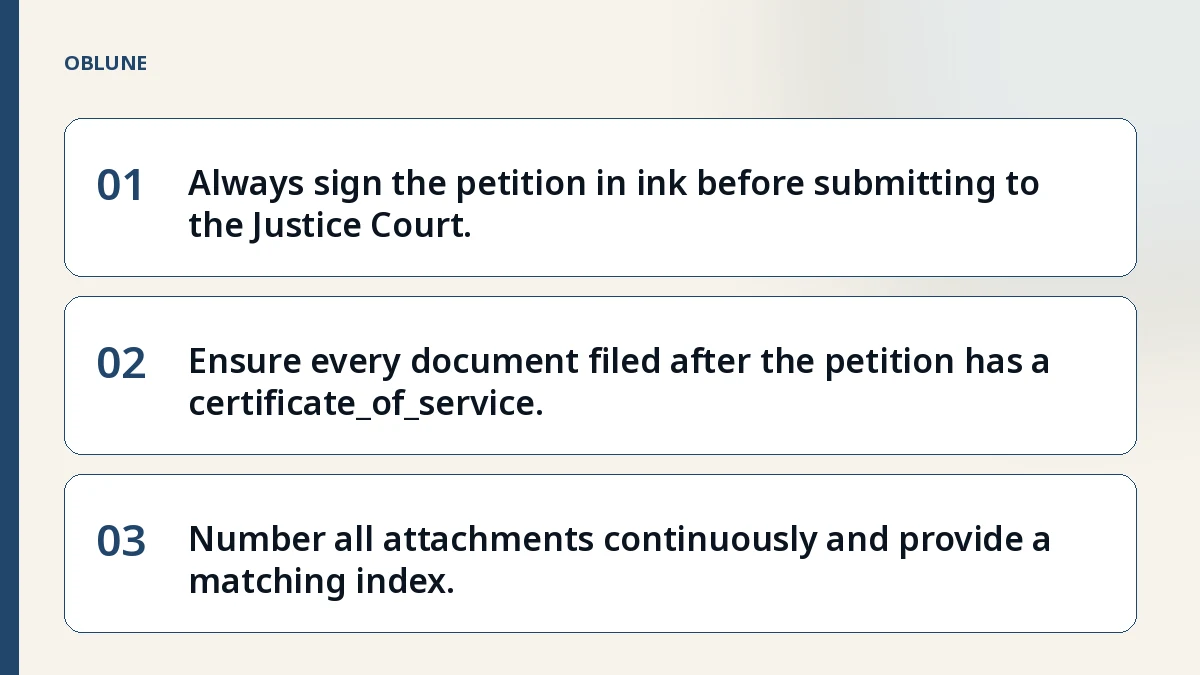
- 01Always sign the petition in ink before submitting to the Justice Court.
- 02Ensure every document filed after the petition has a certificate_of_service.
- 03Number all attachments continuously and provide a matching index.
A contractor took your security deposit and just stopped answering calls. You need to file in Justice Court, but getting your initial filing rejected because of a small paperwork error is frustrating. Understanding what the court needs for small claims court evidence is key to moving forward without a lawyer.
Why Your Filing Might Get Delayed or Rejected
Not every small issue immediately becomes a case. The clerk checks the paperwork first. If the petition is missing a signature or the attachment numbering is off, the clerk will return it. This delay costs you time and potentially more in filing fees. Always check the court’s current instructions, as rules can change.
The Five Mistakes and Their Fixes
- Missing Signature: The petition must be signed in ink. Fix: Ensure the signature block is completed in ink before submitting. (See Texas Rules of Civil Procedure, Rule 57).
- No Certificate of Service: Every document after the initial petition needs proof it was sent to the other side. Fix: Include a certificate_of_service stating the date and manner of delivery.
- Unnumbered Attachments: Exhibits must be numbered continuously, and an index page must match. Fix: Number all attachment pages sequentially starting from 1 and create a clear index.
- Incomplete Caption: Omissions like the court name or a party's full street address stop service. Fix: Double-check the caption to ensure all required addresses and the correct court name are present (Texas Rules of Civil Procedure, Rule 79).
- Wrong Court Limit: If your claim exceeds $20,000, Justice Court is not the right place. Fix: Verify your claim amount is within the Justice Court limit before paying the filing_fee.
Preparing Your Core Documents
When building your case, clarity matters more than complexity. The court needs specific facts, not just complaints. Keep these items organized:
- Signed original petition (on paper, numbered paragraphs)
- One copy for the court, one for each respondent
- The correct filing_fee or a completed Statement of Inability to Afford Payment of Court Costs
- A clear statement_of_facts detailing the dispute.
What to Include in Your Evidence File
Your evidence must directly support the facts you state. Do not include irrelevant personal documents. Focus on the transaction or agreement in question. For example, if you are dealing with an unpaid invoice, you need the invoice itself, not just an email about it.
Essential Documents Checklist
- Copies of the contract or lease pages you rely on.
- Proof of payment (bank statements, Venmo screenshots if applicable).
- Correspondence (emails, texts) showing the dispute timeline.
- Any written agreement or invoice.
Locating Your Local Justice Court
If you are unsure where to file, start by looking up the correct county and precinct. Filing in the wrong location causes immediate delays. You can find general information about the system here: /en/us-tx/.
Next Steps After Filing
Once the petition is filed and you have a cause_number, the process moves to service of process. Remember that for any document filed after the initial petition, you must include a certificate_of_service to prove the other side was notified. Review the preparation steps here: /en/us-tx/prepare/.
Building a Strong Case for Small Claims Court Evidence
Gathering solid small claims court evidence is about being precise. Ensure all your attachment pages are numbered correctly and referenced in an index. This attention to detail helps the clerk process your filing quickly, allowing you to focus on the dispute itself. This structured approach to small claims court evidence can prevent unnecessary setbacks.
Related reading
Check the filing format before you file
See what the court in your region asks for, and what a prepared package contains.
Common questions
How much is the filing fee?
The court sets the **filing_fee**; check the current schedule at the courthouse. If you cannot afford it, you can file a Statement of Inability to Afford Payment of Court Costs.
What is the limit for Justice Court?
Justice Court civil jurisdiction generally covers claims up to $20,000, excluding interest and costs. Larger claims require a different court.
Do I need a lawyer for Justice Court?
Self-representation is allowed in Justice Court. However, following the correct filing procedures is crucial to avoid rejection.
What is a certificate of service?
It is a document stating when and how you delivered a copy of your filing to the respondent. This is required for everything filed after the initial petition.
Official sources
General information about court filing formalities. Not legal advice, and no attorney-client relationship is created. Filing rules change; check the court's current published instructions before you file.