
















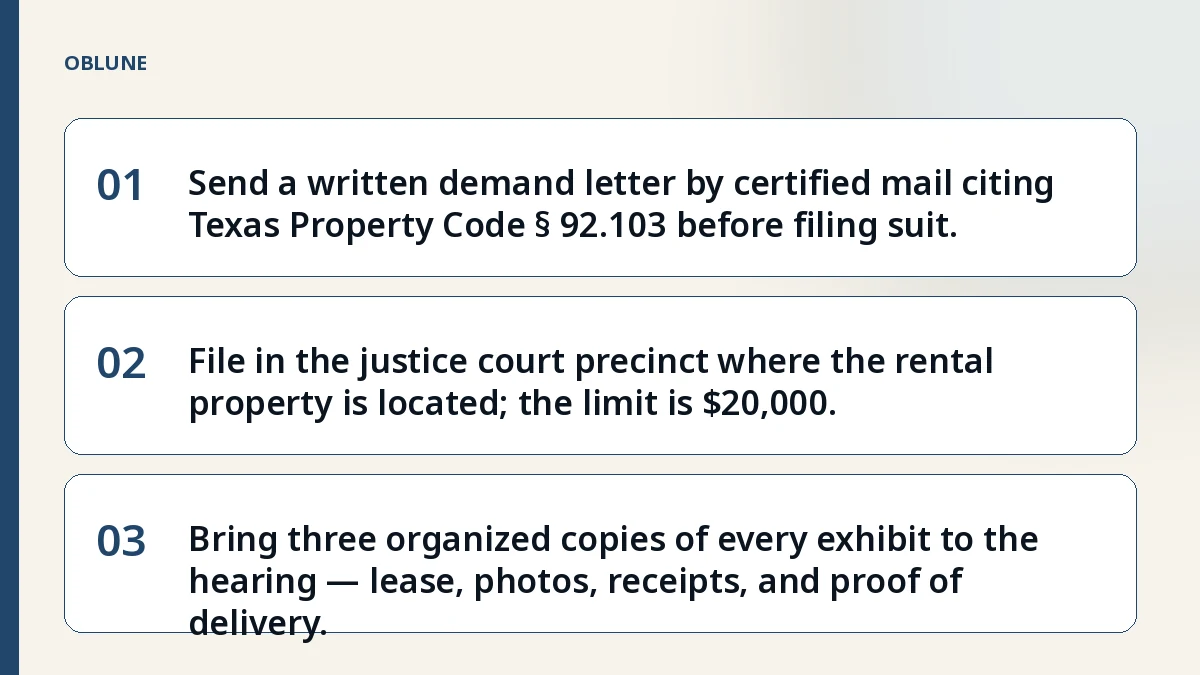
- 01Send a written demand letter by certified mail citing Texas Property Code § 92.103 before filing suit.
- 02File in the justice court precinct where the rental property is located; the limit is $20,000.
- 03Bring three organized copies of every exhibit to the hearing — lease, photos, receipts, and proof of delivery.
The Move-Out That Started It All
Maria rented a two-bedroom apartment in Dallas for two years. When she moved out in September 2026, the landlord kept her $1,800 security deposit and sent only a vague text about "carpet cleaning" with no itemized list. Texas Property Code § 92.103 requires the landlord to provide a written description of deductions within 30 days. That deadline passed with no letter, so Maria started building her case.
What the Demand Letter Needs to Include
A security deposit demand letter template should state the exact deposit amount, the move-out date, the forwarding address you gave the landlord, and a clear request for the full refund or an itemized accounting. Cite Texas Property Code § 92.103 and note that failure to comply can mean liability for three times the deposit plus attorney fees. Keep the tone factual, not threatening. Attach copies of your lease, move-in photos, and the forwarding address notice you sent.
Sending the Letter: Proof of Delivery Matters
Send the demand letter by certified mail with return receipt requested, and also by email if you have the landlord's address. Save the green card, the tracking screenshot, and the email sent confirmation. The justice court will want proof the landlord received it. If the landlord ignores the letter, you have the foundation for a small claims suit. Rules change, so check the court's current instructions before you mail.
Waiting Period: What Happens Next
After the landlord receives the demand letter, Texas law gives them a reasonable time to respond — usually 10 to 14 days is considered reasonable in practice. During this window, gather every document: lease, move-in/move-out inspection sheets, photos, texts, emails, and bank records showing the deposit payment. Organize them chronologically. If the landlord replies with a partial refund or a disputed list, compare it to your records and note every discrepancy.
Filing in Justice Court: The Paperwork Checklist
When the landlord does not respond or the offer is too low, file in the justice court for the precinct where the rental property sits. The claim limit is $20,000, so a typical deposit dispute fits. Here is the filing sequence the clerk checks:
- One signed original petition with numbered paragraphs and a completed caption.
- One copy for each respondent plus one for the court file.
- The filing fee or a sworn Statement of Inability to Afford Payment of Court Costs.
- Your full name and street address, and the landlord's full name and street address.
- Signature in ink with printed name, address, and phone beneath it.
- A certificate of service for any document filed after the petition.
- Attachments numbered continuously from 1 with an index page.
- If you rely on the lease, include the relevant pages.
Common rejections: unsigned petition, missing certificate of service, attachments not numbered, wrong precinct, or claim over $20,000. See Texas Rules of Civil Procedure, Rule 502 for justice court commencement details.
Service of Process: Constable or Private Server
After filing, the clerk issues a citation. You must arrange service of process on the landlord. In most counties you can hire the constable or a private process server. The server completes a return of service that gets filed with the court. Without a valid return, the judge cannot hear the case. Budget for the service fee; the court sets the fee and it varies by county.
Preparing for the Hearing: Evidence Table
Bring three copies of everything — one for you, one for the landlord, one for the judge. Organize with this simple table:
| Exhibit | Description | Source |
|---|---|---|
| 1 | Lease agreement (pages on deposit) | Your file |
| 2 | Move-in inspection checklist | Landlord provided |
| 3 | Move-out photos (dated) | Your phone |
| 4 | Forwarding address notice (certified mail receipt) | USPS tracking |
| 5 | Demand letter + certified mail green card | Your records |
| 6 | Bank statement showing deposit payment | Your bank |
| 7 | Landlord's text about "carpet cleaning" | Screenshot |
Label each exhibit clearly. The judge will flip through them during the hearing.
The Hearing Day: What to Expect
Arrive 20 minutes early. Check the docket sheet for your cause number. When your case is called, stand at the podium. The judge may ask you to summarize in two minutes. Stick to facts: deposit amount, move-out date, forwarding address given, no itemized list received within 30 days, demand letter sent, no response. Let the exhibits speak. Do not argue law unless the judge asks. The landlord may show up or default.
After the Judgment: Collecting What You're Owed
If you win, the judge signs a judgment. The landlord has 30 days to appeal. If they don't pay, you can request a writ of execution or an abstract of judgment. Collection tools include bank garnishment or a turnover order. The justice court clerk can explain the forms, but they cannot give legal advice. For step-by-step help, use the guided preparation flow or review short procedural guides.
Related reading
Check the filing format before you file
See what the court in your region asks for, and what a prepared package contains.
Common questions
How long does a landlord have to return a security deposit in Texas?
The landlord must return the deposit or provide a written itemized list of deductions within 30 days after you surrender the premises and give a forwarding address.
Can I sue for three times the deposit if the landlord ignores the demand letter?
Texas Property Code § 92.103 allows a tenant to recover three times the amount wrongfully withheld plus reasonable attorney fees if the landlord acts in bad faith.
What if the landlord lives in a different county?
You file in the justice court precinct where the rental property is located, not where the landlord lives. The citation can be served anywhere in Texas.
Do I need a lawyer for a security deposit case in justice court?
No. Self-representation is allowed and common in justice court. The procedures are designed for people without attorneys.
Official sources
General information about court filing formalities. Not legal advice, and no attorney-client relationship is created. Filing rules change; check the court's current published instructions before you file.