
















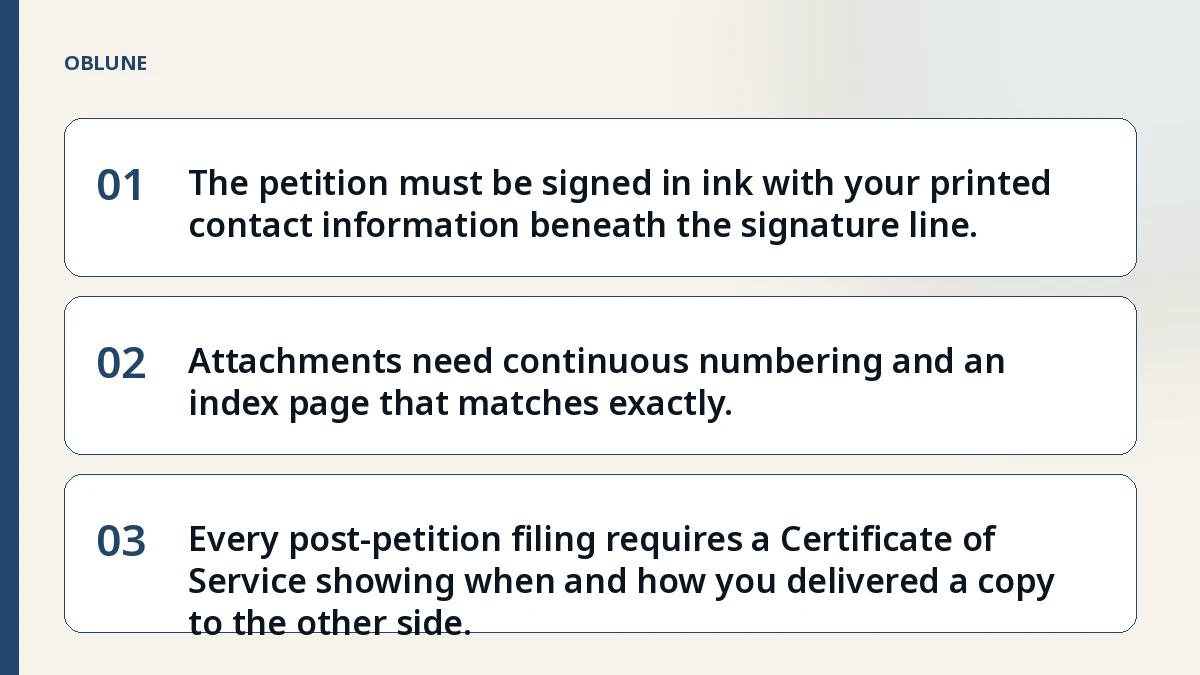
- 01The petition must be signed in ink with your printed contact information beneath the signature line.
- 02Attachments need continuous numbering and an index page that matches exactly.
- 03Every post-petition filing requires a Certificate of Service showing when and how you delivered a copy to the other side.
The Scene: A Contractor Walks Off a Dallas Kitchen Job
You paid a $4,500 deposit to a contractor who demolished your kitchen backsplash, loaded his tools, and stopped returning texts. The justice court in your precinct handles claims up to $20,000, so the amount fits. You need a hearing date, but the clerk will not issue one until the claim package is complete.
What the Justice Court Expects in a Complete Package
Every justice court in Texas follows the same core rules for starting a suit. The clerk looks for a signed petition, properly numbered attachments, a certificate of service for anything filed after the petition, and either the filing fee or a sworn statement of inability to pay. Miss one piece and the clerk hands the stack back. Rules change, so the court's current instructions control.
The Petition: Your Opening Document
The petition is a single document with numbered paragraphs. The caption must show the justice court name, county, precinct, your full name and street address as Plaintiff, and the contractor's full name and street address as Defendant. You write a concise Statement of Facts: what you agreed to, what you paid, what the contractor did, and the dollar amount you seek. Sign in ink on the signature line, then print your name, address, and phone number beneath it. An unsigned pleading is struck under Rule 57.
Attachments and the Index That Holds Them Together
Attach every document you rely on. If the claim rests on a written contract, include the pages that show scope, price, and signatures. Number attachments continuously from 1. Create an index page that lists each attachment by number and name. The clerk compares the index to the stack; mismatches get returned. Texas Rules of Civil Procedure, Rule 45 governs pleading form.
| Attachment No. | Description | Why It Matters |
|---|---|---|
| 1 | Signed contract pages (scope, price, signatures) | Proves the agreement terms |
| 2 | Deposit receipt or bank screenshot | Shows you paid $4,500 |
| 3 | Text messages or emails about work stoppage | Documents the breach |
| 4 | Photos of demolished backsplash | Shows partial performance |
| 5 | Written demand letter sent by certified mail | Satisfies pre-suit notice if required |
Service of Process: Getting the Papers to the Other Side
After you file, the court issues citation. A constable or private process server delivers the petition and citation to the Defendant. You cannot serve the papers yourself. Once service is complete, the server files a return with the court. For any document you file after the petition, you must include a Certificate of Service stating the date and manner of delivery to the other side. Rule 21a sets the service requirements.
Filing Fee or Fee Waiver: What to Bring to the Clerk
The court sets the fee. Bring cash, money order, or a card the clerk accepts. If you cannot pay, complete a Statement of Inability to Afford Payment of Court Costs (Rule 145). The clerk reviews it the same day. Do not leave this line blank; an incomplete fee section stops the filing.
Checklist Before You Walk In
- One signed original petition with numbered paragraphs and completed caption.
- One copy of the petition for each Defendant plus one for the court file.
- Filing fee or signed Statement of Inability to Afford Payment of Court Costs.
- Attachments numbered 1 through N with a matching index page.
- Certificate of Service on any document filed after the petition.
- Correct justice court, county, and precinct for where the work was to be performed.
- Claim amount at or below $20,000 excluding interest and costs.
After Filing: What Happens Next
The clerk assigns a Cause No. and issues citation. The constable serves the Defendant. The Defendant has a deadline to answer. If no answer is filed, you can request a default judgment under Rule 502.6. If the Defendant answers, the court sets a hearing date. Bring your complete evidence file — originals for the judge, copies for the other side. For a deeper walk-through of the hearing itself, see the Small Claims Court Hearing Process: Texas Costs and Logistics.
Related reading
Check the filing format before you file
See what the court in your region asks for, and what a prepared package contains.
Common questions
Can I file in any justice court in the county?
No. You must file in the precinct where the contract was to be performed or where the Defendant lives. Filing in the wrong precinct gets the case rejected.
What if the contractor's address is a P.O. box?
The petition requires a street address for service. If you only have a P.O. box, the constable cannot serve citation there. You need a physical address for the Defendant.
Do I need to attach the entire contract?
Attach only the pages you rely on — scope of work, price, signatures, and any termination clause. The index should list each page or section by number.
What happens if the clerk rejects my package?
The clerk will tell you the specific reason — missing signature, no index, wrong court, etc. Fix the issue and refile. There is no penalty for refiling a corrected package.
Official sources
General information about court filing formalities. Not legal advice, and no attorney-client relationship is created. Filing rules change; check the court's current published instructions before you file.