

















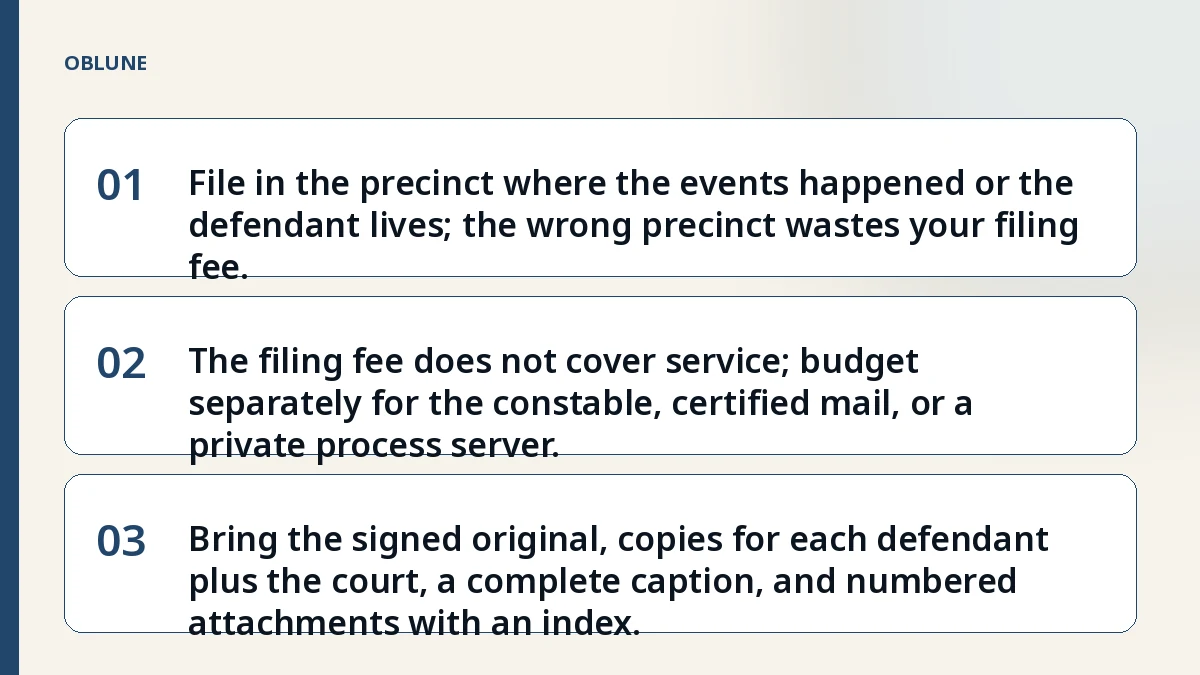
- 01File in the precinct where the events happened or the defendant lives; the wrong precinct wastes your filing fee.
- 02The filing fee does not cover service; budget separately for the constable, certified mail, or a private process server.
- 03Bring the signed original, copies for each defendant plus the court, a complete caption, and numbered attachments with an index.
You drove to the wrong precinct and the clerk sent you home
Maria Rodriguez drove to the Bexar County Justice Court in Precinct 2 last Tuesday carrying a folder of texts, photos, and a lease she hoped would get her $1,800 security deposit back. She left an hour later because the clerk couldn't accept her petition without a Certificate of Service and the correct number of copies.
That scene plays out in justice courts across Texas every weekday. The rules are public, but the practical details — which precinct, how many copies, what the constable charges — are scattered across county websites and clerk's office bulletin boards. This article puts the logistics in one place so you can walk in ready.
Finding the right justice court for your claim
Texas Justice Courts are organized by county and precinct. You file where the events happened or where the defendant lives. A claim for a security deposit on a San Antonio apartment goes to the Bexar County precinct covering that address, not the one near your new job in New Braunfels. The court's jurisdictional limit is $20,000, excluding interest and costs. If your demand exceeds that, you belong in County Court at Law, which has a higher limit that varies by county.
Check the county website for a precinct map before you drive. Some counties let you search by ZIP code. If you file in the wrong precinct, the clerk will reject the petition and you lose the filing fee.
What the filing fee actually covers
The filing fee opens the case and gets you a Cause No. It does not cover serving the defendant. The court sets the fee, and it varies by county. Call the clerk or check the county website for the current schedule. You pay once when you file the petition. If you need to amend later, there may be an additional fee.
Bring a money order, cashier's check, or credit card. Many justice courts do not accept personal checks or cash. Confirm acceptable payment methods before you go.
Fee waiver: Statement of Inability to Afford Payment of Court Costs
If you cannot pay the filing fee, you can file a Statement of Inability to Afford Payment of Court Costs (sometimes called a pauper's affidavit). Texas Rule of Civil Procedure 145 governs the form and the court's review. The clerk will give you the form or you can download it from the county site. You must swear to your income, expenses, and assets. The judge may approve it, deny it, or set a hearing. If denied, you must pay the fee before the case proceeds.
Service of process: constable, certified mail, or private server
After the clerk accepts your petition, you must deliver a copy to the defendant. This is called service of process. You have three main options in justice court:
- Constable or sheriff: The clerk issues a citation; you take it to the constable's office for the precinct where the defendant lives. The constable charges a separate fee, set by the county. This is the most common method.
- Certified mail, return receipt requested: Allowed if the defendant is in Texas. You mail the citation and petition; the green card returned to you proves service. You file the return receipt with the court.
- Private process server: Licensed servers charge their own rates. You file their affidavit of service with the court.
Texas Rule of Civil Procedure 21a covers service of notices and documents after the initial citation. Rule 502 governs commencement of suit in justice court. Check the current rules on the Texas Courts website.
Checklist: Documents you need before you walk in
- One signed original petition with numbered paragraphs and a completed caption (court name, county, precinct, your full name and street address, defendant's full name and street address).
- One copy of the petition for each defendant, plus one copy for the court file.
- The filing fee or a completed Statement of Inability to Afford Payment of Court Costs.
- Your signature in ink on the signature line, with your printed name, address, and telephone number beneath it.
- If you are filing anything after the petition, a Certificate of Service stating the date and manner you delivered a copy to the other side.
- Attachments numbered continuously from 1, with an index page listing each attachment by number and name.
- If your claim rests on a written lease or contract, a copy of the pages you are relying on.
Common filing mistakes that cost time
- Unsigned petition: An unsigned pleading is struck. The signature block must be completed in ink before filing (Texas Rule of Civil Procedure 57).
- Missing Certificate of Service: Every document filed after the petition must state when and how a copy went to the other side (Rule 21a).
- Attachments not numbered continuously: Exhibits are returned when the index does not match the pages attached.
- Caption omits a party's address or the court name: The clerk cannot issue service without them (Rule 79).
- Stated amount exceeds the justice court limit: The claim is filed in the wrong court.
- Wrong county or precinct: The case is dismissed or transferred, and you lose time.
After filing: what happens next
Once the petition is accepted and the defendant is served, the court sets an answer date. The defendant typically has 14 days after service to file an answer. If they do not answer, you can request a default judgment under Rule 502.6. If they answer, the court schedules a hearing. You will receive notice of the date, time, and location. Bring all originals and enough copies for the judge, the defendant, and yourself.
Rules change. The court's current instructions control. Verify fees, forms, and deadlines with the clerk the week you plan to file.
Where to check current fees and forms
Start with the county justice court website. Search for "justice court civil filing fee schedule" plus your county name. The Texas Courts site publishes the Rules of Civil Procedure. For a guided preparation flow that builds your petition and attachments, use the tool linked below. The clerk's office can confirm the precinct map and acceptable payment methods by phone.
Related reading
Check the filing format before you file
See what the court in your region asks for, and what a prepared package contains.
Common questions
How do I know which justice court precinct to use?
Use the county's precinct map, often searchable by ZIP code, to find the precinct covering the address where the dispute arose or where the defendant lives. Filing in the wrong precinct gets your case rejected.
Can I pay the filing fee with a personal check?
Most justice courts do not accept personal checks or cash. Bring a money order, cashier's check, or credit card. Call the clerk to confirm accepted payment methods before you go.
What if I cannot afford the filing fee?
File a Statement of Inability to Afford Payment of Court Costs (Rule 145). The judge reviews it and may approve, deny, or set a hearing. If denied, you must pay before the case proceeds.
Does the filing fee include serving the defendant?
No. The filing fee only opens the case. Service of process — by constable, certified mail, or private server — costs extra and is paid separately.
Official sources
General information about court filing formalities. Not legal advice, and no attorney-client relationship is created. Filing rules change; check the court's current published instructions before you file.