
















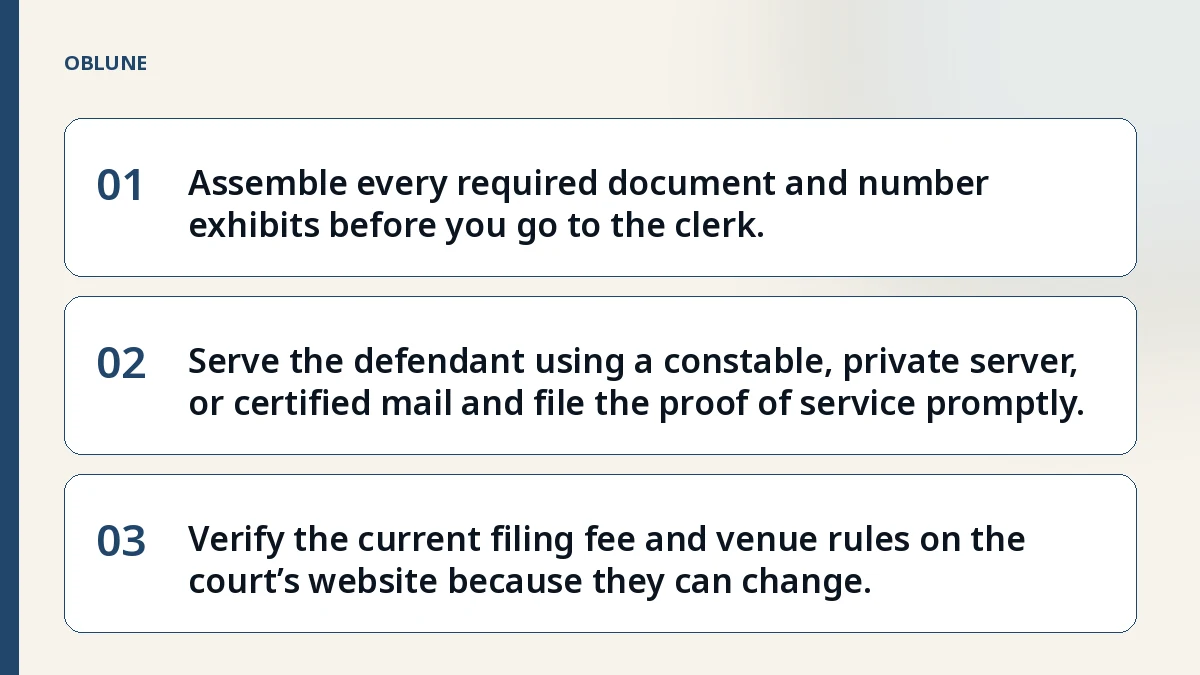
- 01Assemble every required document and number exhibits before you go to the clerk.
- 02Serve the defendant using a constable, private server, or certified mail and file the proof of service promptly.
- 03Verify the current filing fee and venue rules on the court’s website because they can change.
When a client ignores your invoice
You sent the invoice, followed up twice, and still no payment. If the amount is $20,000 or less, a small claims for unpaid invoice case in a Texas justice court is often the fastest way to get a judgment without a lawyer.
The justice court handles claims up to $20,000, excluding interest and costs, and you can represent yourself. Rules change, so always verify the court’s current instructions before you file.
Pick the right justice court and venue
File in the precinct where the contract was signed, where the work was performed, or where the defendant lives. Filing in the wrong county or precinct is a common rejection reason. The Texas Rules of Civil Procedure, Rule 502 (commencement of suit) sets the venue rules for justice courts. Texas Rules of Civil Procedure, Rule 502
If the claim exceeds $20,000 you must use a county court at law instead. Check the current schedule for any jurisdictional updates.
Gather the paperwork you’ll file
You need a complete packet before you walk up to the clerk. The following items are required for every petition: - One signed original petition with numbered paragraphs and a completed caption - One copy of the petition for each respondent plus one for the court file - The filing fee, or a completed Statement of Inability to Afford Payment of Court Costs if you cannot pay - Court name, county, precinct, your full name and street address, and the respondent’s full name and street address - Signature in ink with printed name, address, and telephone number beneath it - A certificate of service for every document filed after the petition - Attachments numbered continuously from 1 with an index page listing each attachment - If the claim rests on a written contract, the relevant pages of that contract
Missing any of these pieces will cause the clerk to return the packet. See the paperwork checklist for a printable version.
Fill out the petition – step‑by‑step
- Write the caption: court name, county, precinct, cause number (leave blank), your name as Plaintiff, and the defendant’s name as Defendant.
- In the Statement of Facts, describe the agreement, the work performed, the invoice date, the amount owed, and any payments received.
- State the exact dollar amount you are claiming, not exceeding the $20,000 limit.
- Attach the contract excerpts, invoices, emails, and any payment records as numbered exhibits.
- Sign the petition in ink, print your name, address, and phone number below the signature line.
- Complete a certificate of service showing when and how you will deliver a copy to the defendant.
The petition must follow the pleading form in Texas Rules of Civil Procedure, Rule 45. Texas Rules of Civil Procedure, Rule 45
Pay the filing fee or request a waiver
The court sets the filing fee; check the current schedule on the court’s website or call the clerk. If you cannot afford it, fill out a Statement of Inability to Afford Payment of Court Costs (Rule 145) and file it with your petition. Texas Rules of Civil Procedure, Rule 145
A fee waiver does not guarantee approval; the judge reviews the affidavit and may ask for supporting financial information.
Serve the defendant and file proof of service
After the clerk stamps your petition, you must serve the defendant. In justice court you can use a constable, a private process server, or certified mail with return receipt requested. The citation tells the defendant the deadline to answer.
File the original proof of service (return of citation, affidavit of service, or signed receipt) with the court. Every document filed after the petition must include a certificate of service under Rule 21a. Texas Rules of Civil Procedure, Rule 21a
What happens after you file
The court will set a hearing date, usually within a few weeks. Both parties can present evidence, call witnesses, and make arguments. If the defendant does not appear, you may request a default judgment under Rule 502.6. Even with a judgment, collecting the money may require a separate enforcement step.
For a guided preparation flow that walks you through each form, visit the guided preparation flow. Avoid common filing mistakes by reviewing the list of common filing mistakes. If you want to understand how the service works end‑to‑end, see how the service works.
Check the filing format before you file
See what the court in your region asks for, and what a prepared package contains.
Common questions
Can I file a small claims case for an unpaid invoice if the client is in another county?
You must file in the precinct where the contract was signed, the work was done, or the defendant resides. Filing in the wrong venue will get your case dismissed.
What if I cannot afford the filing fee?
Submit a Statement of Inability to Afford Payment of Court Costs (Rule 145) with your petition. The judge will review it and decide whether to waive the fee.
Do I need a lawyer to appear at the justice court hearing?
No. Self‑representation is allowed in justice court, and many people handle the hearing themselves.
What happens after I win a judgment?
A judgment orders the defendant to pay, but you may need to take additional steps such as a writ of execution or bank levy to actually collect the money.
Official sources
General information about court filing formalities. Not legal advice, and no attorney-client relationship is created. Filing rules change; check the court's current published instructions before you file.