
















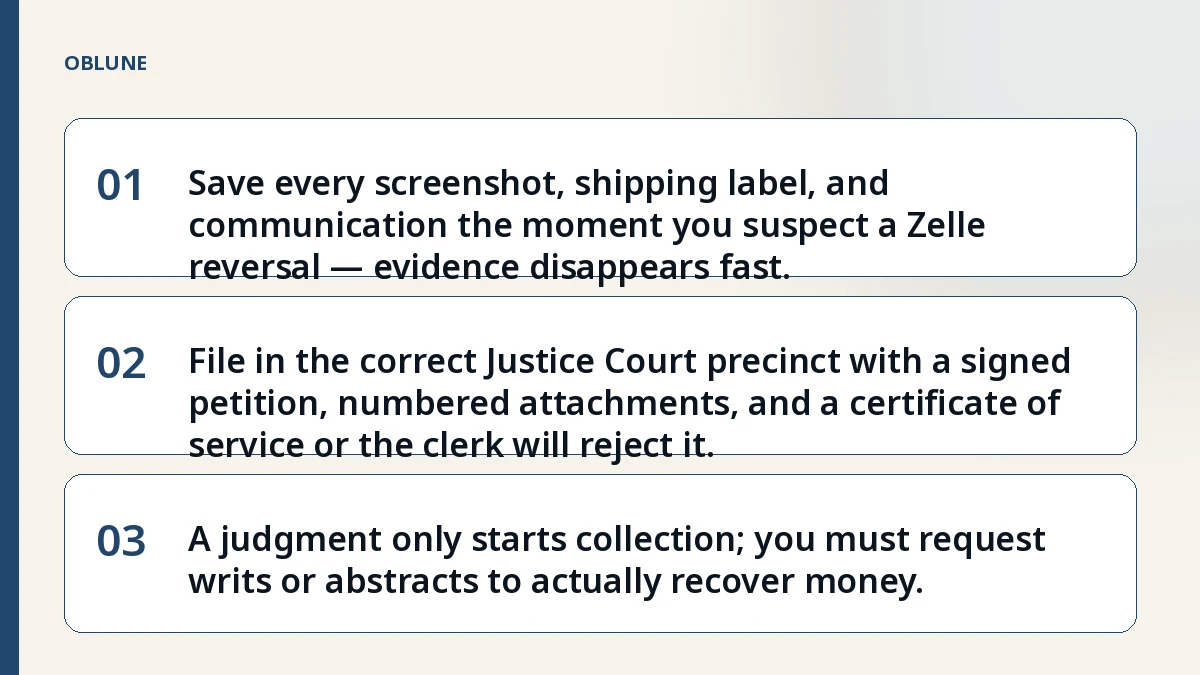
- 01Save every screenshot, shipping label, and communication the moment you suspect a Zelle reversal — evidence disappears fast.
- 02File in the correct Justice Court precinct with a signed petition, numbered attachments, and a certificate of service or the clerk will reject it.
- 03A judgment only starts collection; you must request writs or abstracts to actually recover money.
The Facebook Marketplace Sale That Went Wrong
You listed a used iPhone 13 on Facebook Marketplace for $450. A buyer messaged, agreed to your price, and sent a Zelle payment that showed up in your Chase app instantly. You shipped the phone the same afternoon. Two days later the $450 vanished from your account with a note: "payment reversed — unauthorized transaction." The buyer stopped responding. This is a common zelle payment scams facebook pattern that leaves sellers with no phone and no money.
Day 1: You Realize the Zelle Payment Is Fake
The reversal notice arrives by email and in your banking app. The money is gone. The buyer's profile is still up but messages go unread. You call Chase; they say the sender's bank flagged the transfer as fraud and pulled it back. Chase cannot reverse the reversal. You have a shipping label with tracking, a screenshot of the Zelle confirmation, and the Marketplace conversation. Save everything now — screenshots, PDFs, the tracking page — before the buyer deletes the listing.
Days 2-7: Demand Letter and Evidence Collection
Texas Justice Court expects you to try resolving the dispute before filing. Write a demand letter: state the facts, attach the evidence, ask for $450 plus your filing fee and service cost, and give a deadline — 14 days is standard. Send it by certified mail with return receipt requested and by email if you have an address. Keep the mailing receipt and the green card when it comes back. This letter becomes Attachment 1 in your petition.
Checklist: Documents You Need Before Filing
- Signed original petition with numbered paragraphs and completed caption
- One copy for each defendant plus one for the court file
- Filing fee or Statement of Inability to Afford Payment of Court Costs
- Your full name, street address, phone; defendant's full name and street address
- Certificate of service for anything filed after the petition
- Attachments numbered continuously from 1 with an index page
- Copy of the Marketplace conversation, Zelle screenshot, shipping label, demand letter, certified mail receipt
- If you have a written agreement, the pages you rely on
Filing in Justice Court: The Paperwork Timeline
You file in the Justice Court for the precinct where the buyer lives or where the transaction occurred. The clerk stamps your petition, assigns a Cause No., and issues a citation. The court sets the filing fee — check the current schedule. If you cannot pay, file a Statement of Inability to Afford Payment of Court Costs under Rule 145. The petition must be signed in ink; an unsigned pleading gets struck. Every attachment needs a continuous number and an index page that matches. The caption must include the court name, county, precinct, and both parties' addresses or the clerk cannot issue service.
Table: Key Deadlines After Filing
| Step | Typical Deadline | What Happens If Missed |
|---|---|---|
| Defendant answers | 14 days after service | Default judgment possible under Rule 502.6 |
| You request trial setting | After answer filed | Case sits dormant |
| Pretrial conference (if ordered) | Court sets date | Court may dismiss for want of prosecution |
| Trial/hearing | Court sets date | No judgment entered |
Service of Process: Getting the Citation to the Scammer
You cannot serve the papers yourself. Hire the constable or a private process server. Give them the citation and a copy of your petition with all attachments. The server files a return of service stating the date, time, and method. If the defendant avoids service, you can ask the court for alternative service — posting at the door or publication — but you must show good faith attempts. The certificate of service on every later filing must match the return.
The Hearing: What to Expect in Court
Justice Court hearings are informal but on the record. Bring three copies of every document: one for you, one for the judge, one for the defendant. Dress neatly. The judge will swear you in. Present your timeline: the listing, the Zelle confirmation, the shipment, the reversal, the demand letter, the certified mail receipt. The defendant may not appear; if they do, they can cross-examine you. The judge decides based on the preponderance of the evidence. Rules change; the court's current instructions control.
After the Judgment: Collecting If You Win
A judgment is not a check. If the defendant does not pay, you can request a writ of execution, ask for a turnover order, or record an abstract of judgment in the county where they own real property. The constable can seize non-exempt assets. Collection takes time and additional fees. The court does not collect for you. For more on the filing process, see the /en/us-tx/prepare/ guided preparation flow.
Related reading
Check the filing format before you file
See what the court in your region asks for, and what a prepared package contains.
Common questions
Can I sue in Justice Court if the buyer lives in another Texas county?
Yes, you can file where the transaction occurred or where the defendant lives. If the buyer is in another county, you may file in your precinct if the sale and shipment originated there. Check venue rules with the clerk.
What if the scammer used a fake name on Facebook Marketplace?
You sue the person you can identify. Use the name on the Zelle transfer, the shipping address, or any real information you have. If you only have a username, you may need to subpoena Facebook or the bank for the real identity before filing.
How much does it cost to file and serve in Justice Court?
The court sets the filing fee; it varies by county. Service by the constable typically costs $75–$100. If you cannot afford either, file a Statement of Inability to Afford Payment of Court Costs with your petition.
Do I need a lawyer for a $450 Zelle scam case?
No. Justice Court is designed for self-representation. The procedures are simpler than higher courts, and the judge will guide you through the hearing. Many people handle these claims without an attorney.
Official sources
General information about court filing formalities. Not legal advice, and no attorney-client relationship is created. Filing rules change; check the court's current published instructions before you file.