
















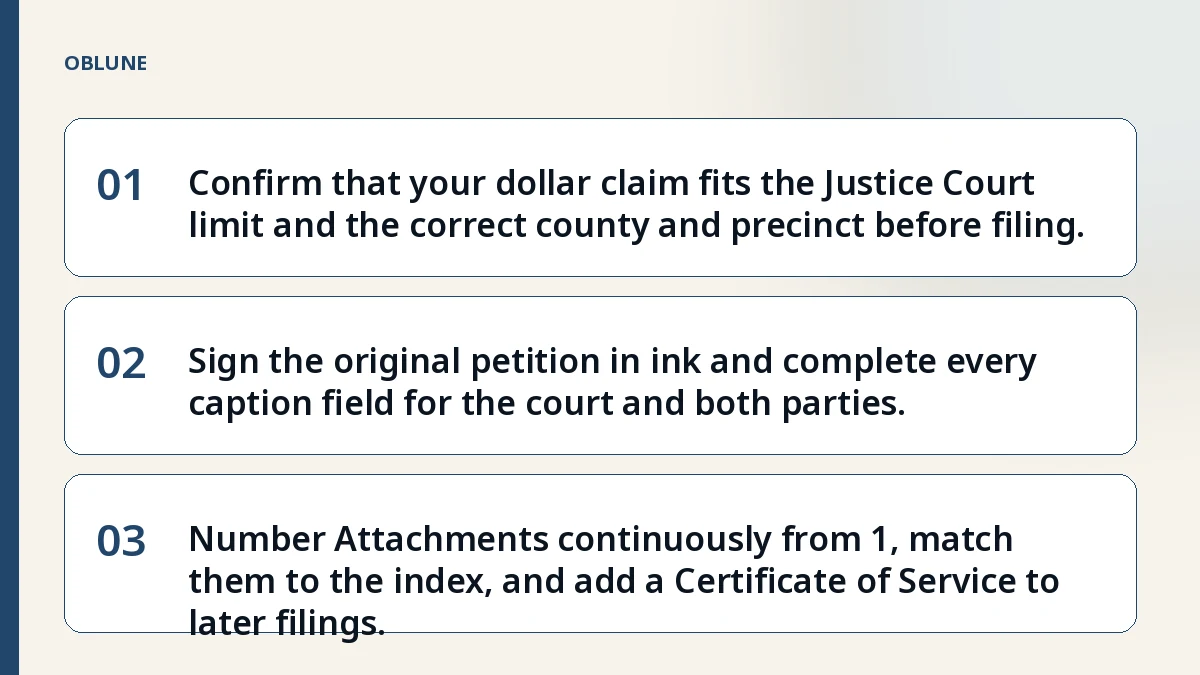
- 01Confirm that your dollar claim fits the Justice Court limit and the correct county and precinct before filing.
- 02Sign the original petition in ink and complete every caption field for the court and both parties.
- 03Number Attachments continuously from 1, match them to the index, and add a Certificate of Service to later filings.
The contractor who left a half-finished bathroom
A Houston homeowner signs a contractor's written estimate for a bathroom renovation, pays a deposit, and then finds the crew gone with the job unfinished. The homeowner asks a neighbor: “Can you take a contractor to small claims court?” The answer may be yes, because Texas Justice Court handles claims up to $20,000, excluding interest and costs, and individuals may represent themselves.
The dispute belongs in small claims court when the money claim fits that limit. Before filing, fix the paperwork problems that most often cause a petition to be struck, returned, or delayed.
Mistake 1: Filing in the wrong court
The amount claimed determines where the filing starts. A Justice Court generally covers claims of $20,000 or less, excluding interest and costs. A claim above that limit may belong in County Court at Law, whose jurisdictional limits vary by county and by the basis of the claim, so check the county's own limit before filing there.
A useful filing checklist is:
- List the money you seek to recover.
- Confirm whether that amount is $20,000 or less.
- Check whether the events happened in the correct county and precinct.
- Decide whether you need a Statement of Facts to explain why the money is owed.
- Use the caption and format required by the court for that filing track.
The concrete fix is to compare your claimed amount and the location of the dispute with the court information before filing. For a broader view of the filing options, see the court page for this jurisdiction. Rules and forms change, so the court's current instructions control.
Mistake 2: Leaving the petition unsigned
You can prepare the claim yourself, but the court will not accept an unsigned pleading. A missing signature is one of the clearest reasons for a filing to be struck rather than reviewed on its merits.
The fix is straightforward: sign the original petition in ink on the signature line. Beneath the signature, include your printed name, street address, and telephone number. Check the signature block before you leave home, and do not rely on a typed name to replace the required signature.
Texas pleading requirements are summarized in Texas Rules of Civil Procedure, Rule 57 (Signing of pleadings). If you are unsure how the local form handles the signature, ask the clerk what the current form requires.
Mistake 3: Omitting an address or the court name
The caption must identify the court and the parties. It must also include your full name and street address and the Respondent's full name and street address. If the caption leaves out an address or the court name, the clerk may be unable to issue service of process.
That problem can stop the case before the hearing because papers cannot be delivered to the right party. Confirm that the court name, county, and precinct are complete, then read the caption against the names and addresses on the contract and your records.
The formatting rules appear in Texas Rules of Civil Procedure, Rules 45 and 79. If a contractor's records contain only a company name, make sure the caption matches the legal party you are suing and follows the court's current instructions.
Mistake 4: Numbering attachments incorrectly
A contractor dispute usually depends on documents: the written estimate, the contract, receipts for the deposit, texts with the contractor, and photographs. Those pages must be labeled as Attachments, numbered continuously from 1, and listed on an index page that matches the pages actually attached.
Here is the document list to prepare before filing:
- One signed original petition on paper, with numbered paragraphs and a completed caption.
- One copy of the petition for each Respondent, plus one copy for the court file.
- The filing fee, or a completed Statement of Inability to Afford Payment of Court Costs if you cannot pay it.
- A Certificate of Service stating the date and manner of delivery for anything filed after the petition.
- An index page listing each Attachment by number and name.
- A copy of the written lease or contract pages supporting the claim, when the claim rests on one.
Number the pages in ink, add the index, and compare the two before filing. An index that does not match the attached pages can cause the exhibits to be returned.
Mistake 5: Omitting the Certificate of Service
The petition starts the lawsuit, but later filings must show that the other side received a copy. Every document filed after the petition needs a Certificate of Service stating when and how the copy went to the Defendant.
The fix is to include that certificate with each post-petition filing and to make sure its description matches what you actually did. A statement that does not describe the delivery method is not a substitute for completing the required certificate. The service requirement is covered in Texas Rules of Civil Procedure, Rule 21a.
If you are unsure how to describe the delivery method, ask the clerk or follow the court's current filing instructions before submitting the document.
Preparing the Statement of Facts
The Statement of Facts is where you explain the dispute in short, organized paragraphs. For a contractor claim, set out the agreement, what the contractor was supposed to do, what happened, and the money you seek to recover. Keep the dates and amounts tied to your documents.
Number the paragraphs and avoid long narrative sections. If the agreement spans several pages, identify the pages you rely on in the Attachment index. You can use the guided preparation flow to organize your materials before completing the form.
The evidence-file guide can help you group the estimate, receipts, messages, and photographs. A clear file also makes it easier to explain what each Attachment proves.
Paying the filing fee
The court charges a filing fee, and the court sets the amount. Pay it with the filing, or complete a Statement of Inability to Afford Payment of Court Costs if you cannot pay. The court may review that statement, so fill it out completely rather than leaving it blank.
The statement is not a way to skip the filing fee without a decision; it is a request for the court to consider your ability to pay. Texas Rule 145 addresses the affidavit of inability to pay court costs. The clerk can confirm the current fee and payment methods.
A final check before you file
Paperwork delays are frustrating because they happen before the court reaches the merits. Read the petition once as though you were the judge: Can you tell what the contract was, what the contractor failed to do, and how much money you seek? Are all names and addresses complete? Is the original signed in ink?
Then count the copies, confirm the Attachments and index match, and check that every document after the petition has a Certificate of Service. If a point remains unclear, ask the clerk about the court's current instructions rather than guessing.
What happens next
Once the court accepts the filing, the process moves toward service of process and a hearing. A failure to appear can produce a default judgment under Justice court rules, so keep track of court dates and respond to notices. For the procedural path, read How to Take a Contractor to Small Claims Court in Texas.
No filing method guarantees a result. Your job is to give the court a complete, signed, properly served set of papers that clearly explains the contractor dispute and the amount claimed.
Check the filing format before you file
See what the court in your region asks for, and what a prepared package contains.
Common questions
Can you take a contractor to small claims court in Texas?
Yes, a contractor may be sued in Justice Court when the claim is $20,000 or less, excluding interest and costs. Individuals may represent themselves, and self-representation is allowed.
What if the contractor's deposit was more than $20,000?
A claim above $20,000 falls outside the Justice Court limit described here and may belong in County Court at Law. County Court limits vary by county and by the basis of the claim, so check the county's own limit before filing.
Will the court reject my case because an attachment is missing from the index?
An index that does not match the attached pages can cause the exhibits to be returned. Number every Attachment continuously from 1 and list each one by number and name on the index page.
Do I need a Certificate of Service with the first petition?
The Certificate of Service requirement applies to documents filed after the petition, and each of those documents must state when and how a copy went to the other side. Include it with the later document when you file it.
Official sources
General information about court filing formalities. Not legal advice, and no attorney-client relationship is created. Filing rules change; check the court's current published instructions before you file.