
















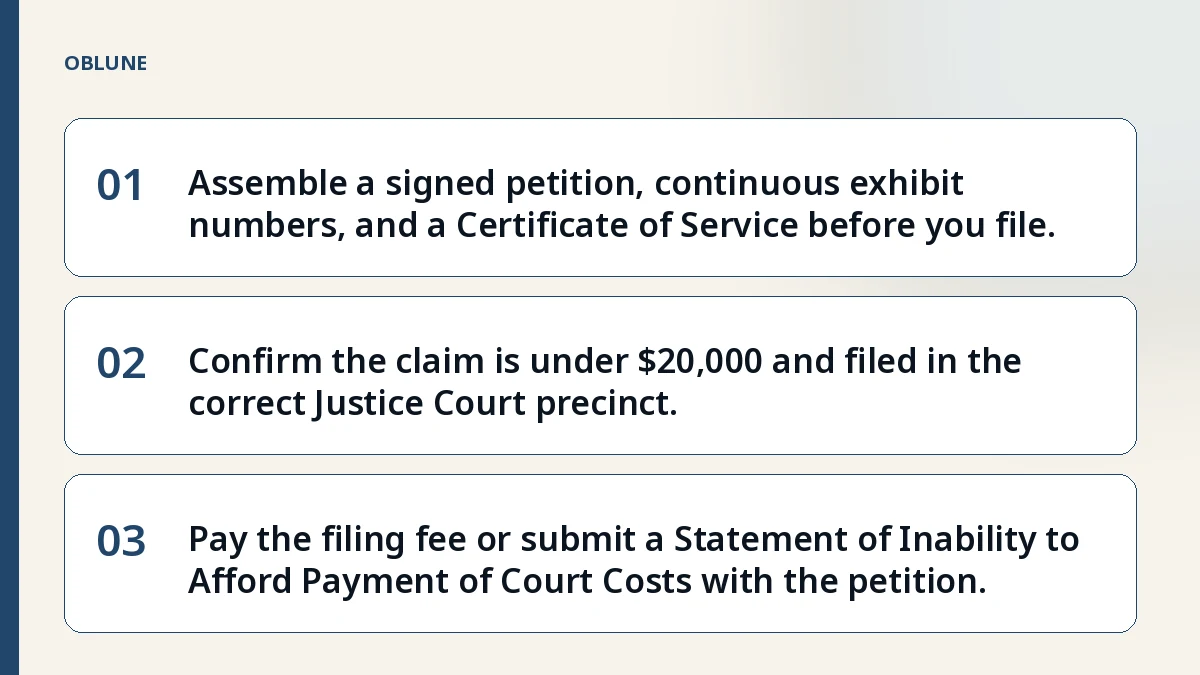
- 01Assemble a signed petition, continuous exhibit numbers, and a Certificate of Service before you file.
- 02Confirm the claim is under $20,000 and filed in the correct Justice Court precinct.
- 03Pay the filing fee or submit a Statement of Inability to Afford Payment of Court Costs with the petition.
You paid a contractor $12,000 for a kitchen remodel in Dallas, but the crew vanished after framing the walls. Now you’re staring at a half‐finished job and a stack of unpaid invoices. If you’re wondering how to take a contractor to small claims court, start by gathering the paperwork the Justice Court requires.
Choose the Right Justice Court and Confirm the $20,000 Limit
Justice Court handles claims up to $20,000, excluding interest and costs. Verify that your dispute falls under this ceiling and that the precinct where the work was performed is the proper venue. Filing in the wrong county or precinct is a common reason the clerk rejects the petition. The Texas Rules of Civil Procedure, Rule 502 (Justice court: commencement of suit) outline the venue rules. You can also use the Texas Justice Court page to locate the correct precinct.
Build the Petition: Caption, Statement of Facts, and Demand
The petition must contain a completed caption with the court name, county, precinct, your full name and address, and the respondent’s full name and address. Number each paragraph and include a clear Statement of Facts that describes the contract, the payments made, and the contractor’s failure to perform. End with a specific demand for the amount you seek. Rule 45 (Pleading form) and Rule 79 (Caption) govern the format. The guided preparation flow can help you draft each section.
Attachments Checklist – What the Judge Expects to See
Attach every document that supports your claim. The clerk will return the filing if attachments are not numbered continuously or if the index does not match the pages. Use the table below as a quick reference, then follow the numbered checklist.
| # | Document | Why It Matters |
|---|---|---|
| 1 | Signed contract or written agreement | Shows the scope and price you agreed to |
| 2 | Invoices, receipts, and cancelled checks | Proves what you paid |
| 3 | Photos of incomplete work | Visual evidence of the breach |
| 4 | Correspondence (texts, emails) | Documents demands and the contractor’s responses |
| 5 | Any warranty or lien waiver forms | May affect recoverable amounts |
Checklist 1. Print one signed original petition with numbered paragraphs. 2. Make one copy for each respondent plus one for the court file. 3. Attach the documents above, numbered continuously from 1. 4. Include an index page listing each attachment by number and name. 5. Add a Certificate of Service stating the date and manner you delivered a copy to the respondent.
The Build the Evidence File the Judge Actually Reads article explains how to organize these exhibits for the judge.
Number Your Exhibits and Add a Certificate of Service
Every attachment becomes an Attachment in the court’s eyes. Number them 1, 2, 3… without gaps. After the petition, any further filing (amended petition, motion, etc.) must carry a Certificate of Service that notes the exact date and method (hand delivery, certified mail, or constable service). Rule 21a (Service of notices and documents) sets the standard. Missing this certificate is a top rejection reason.
Pay the Filing Fee or File a Statement of Inability to Afford
The court sets the filing fee; check the current schedule on the county website or ask the clerk. If you cannot pay, complete a Statement of Inability to Afford Payment of Court Costs (Rule 145) and file it with the petition. The Costs and Logistics Before You File guide walks through the fee waiver process.
Serve the Respondent and Track the Cause Number
After the clerk stamps the petition, you must arrange service of process. A constable or private process server can deliver the citation and petition to the respondent. Once served, the court will assign a Cause No. Keep that number on every later filing. The short procedural guides page has a printable service checklist.
Final Review Before You File
Rules change and the court’s current instructions control. Before you walk to the clerk’s office, run through the checklist one more time: signed petition, correct caption, continuous exhibit numbers, index page, Certificate of Service, filing fee or waiver, and proper venue. A clean package reduces the chance of a rejection and gets your hearing date sooner.
Check the filing format before you file
See what the court in your region asks for, and what a prepared package contains.
Common questions
What happens if my petition is missing a signature?
An unsigned pleading is struck by the clerk. You must sign in ink on the signature line and include your printed name, address, and phone number before the court will accept it.
Can I serve the contractor myself?
No. Service of process must be performed by a constable, sheriff, or authorized private process server. Personal delivery by the plaintiff does not satisfy the rule.
Do I need a lawyer to file in Justice Court?
Self‐representation is allowed in Justice Court. The rules are designed for individuals to handle their own small claims without an attorney.
What if the contractor files a counterclaim?
A counterclaim is treated like a separate claim in the same case. You must respond in writing before the hearing, and the judge will consider both sides at the same trial.
Official sources
General information about court filing formalities. Not legal advice, and no attorney-client relationship is created. Filing rules change; check the court's current published instructions before you file.