
















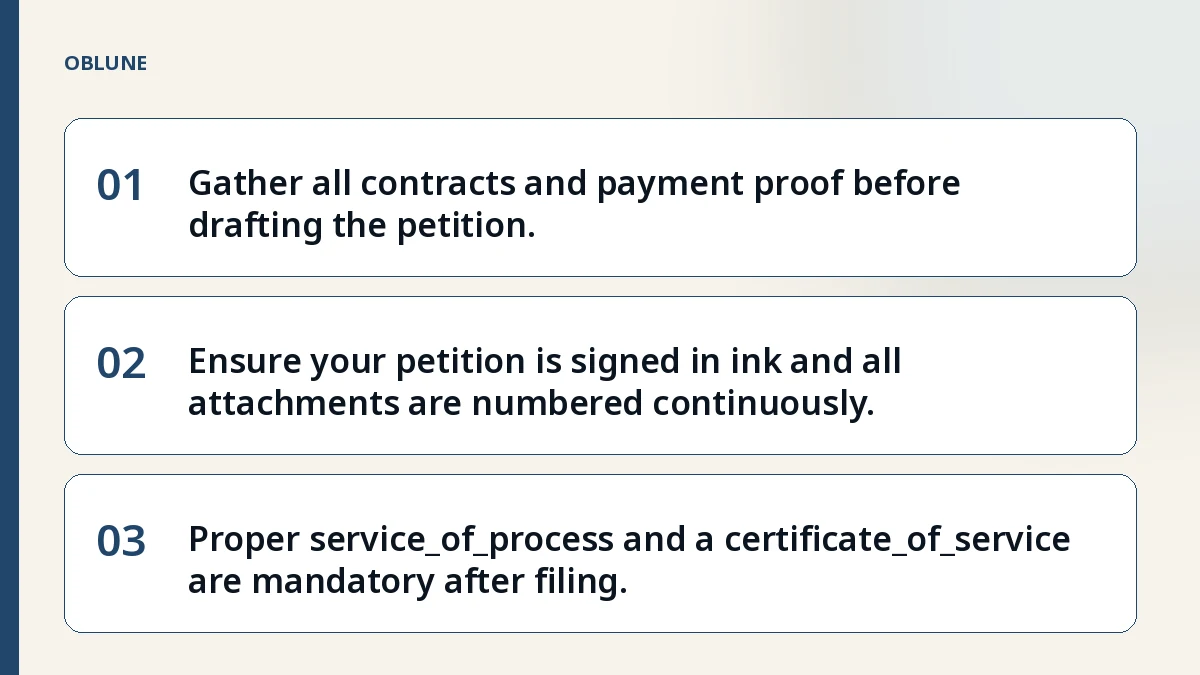
- 01Gather all contracts and payment proof before drafting the petition.
- 02Ensure your petition is signed in ink and all attachments are numbered continuously.
- 03Proper service_of_process and a certificate_of_service are mandatory after filing.
The crew took your $3,000 deposit for the deck build, and now there’s no answering phone. You need to know the practical steps before you try to sue a contractor in small claims court. This isn't about legal theory; it's about the paperwork and the actual money involved in Justice Court.
Understanding the Justice Court Limit
In Texas, Justice Court handles civil claims up to $20,000. If the contractor owes you more than that, you might need to look into the County Court at Law, but for most small job disputes, Justice Court is the right place. Always check the current schedule because court rules can change, and the court’s current instructions control the process.
Initial Preparation: Gathering Facts, Not Just Anger
Before you even think about the filing fee, organize your evidence. A judge cares about what happened, not just how frustrated you are. You need clear documentation to support your claim against the respondent.
Essential Documents to Collect
- Signed contract or agreement.
- Proof of payment (bank statements, Zelle records).
- Emails or texts detailing the work scope and missed deadlines.
- Photographs of the incomplete work.
The Paperwork Checklist
Filing requires specific documents to avoid immediate rejection by the clerk. Missing a signature or not numbering attachments correctly is a common mistake. Reviewing the requirements helps you get through the initial hurdle.
- One signed original petition, with numbered paragraphs and the caption filled out.
- One copy of the petition for each respondent, plus one copy for the court file.
- The filing fee, or a completed Statement of Inability to Afford Payment of Court Costs if you cannot pay it.
- Ensure the caption includes the correct court name, county, and both parties' full street addresses.
- Include a certificate_of_service for any documents filed after the initial petition.
What About the Filing Fee?
There is a filing fee associated with starting the case in Justice Court. If you cannot afford it, you can file a Statement of Inability to Afford Payment of Court Costs. Check the current schedule for the exact amount, as the court sets the fee, not an outside body.
Serving the Respondent
Filing the petition is only half the battle; you must properly notify the contractor. This is called service_of_process. After filing, you must provide a certificate_of_service detailing when and how you delivered a copy to the other side. This step is crucial for the case to move forward.
Common Rejection Reasons to Avoid
Clerks send back petitions for simple administrative errors. Don't let a technicality stall your case. Be meticulous with these points:
- The petition is not signed in ink.
- Missing certificate_of_service on subsequent filings.
- Attachments are not numbered continuously from 1.
- The stated claim amount exceeds the $20,000 limit for Justice Court.
Next Steps After Filing
Once the case is filed and served, you wait for the court's direction. If the respondent does not respond, the court may consider a default judgment. For guidance on the process, review the prepare/ flow or look at en/articles/texas-justice-court-small-claims-costs-logistics/. If you need general court information, visit en/courts/. This process can be managed by following the general steps outlined in en/how-it-works/.
Check the filing format before you file
See what the court in your region asks for, and what a prepared package contains.
Common questions
Do I need a lawyer to sue a contractor in small claims court?
No, self-representation is allowed in Justice Court. However, understanding the specific filing requirements is vital for a smooth process.
What is the limit for a claim in Texas Justice Court?
The general limit for a claim in Justice Court is $20,000, excluding interest and costs. Claims above this amount require a different court.
How do I pay the filing fee if I can't afford it?
You can file a Statement of Inability to Afford Payment of Court Costs instead of paying the filing fee. Check the rules for the correct form.
What happens after I file the petition?
After filing, you must serve the respondent and then provide a certificate_of_service. The court will then move the case forward based on the respondent's response.
Official sources
General information about court filing formalities. Not legal advice, and no attorney-client relationship is created. Filing rules change; check the court's current published instructions before you file.