
















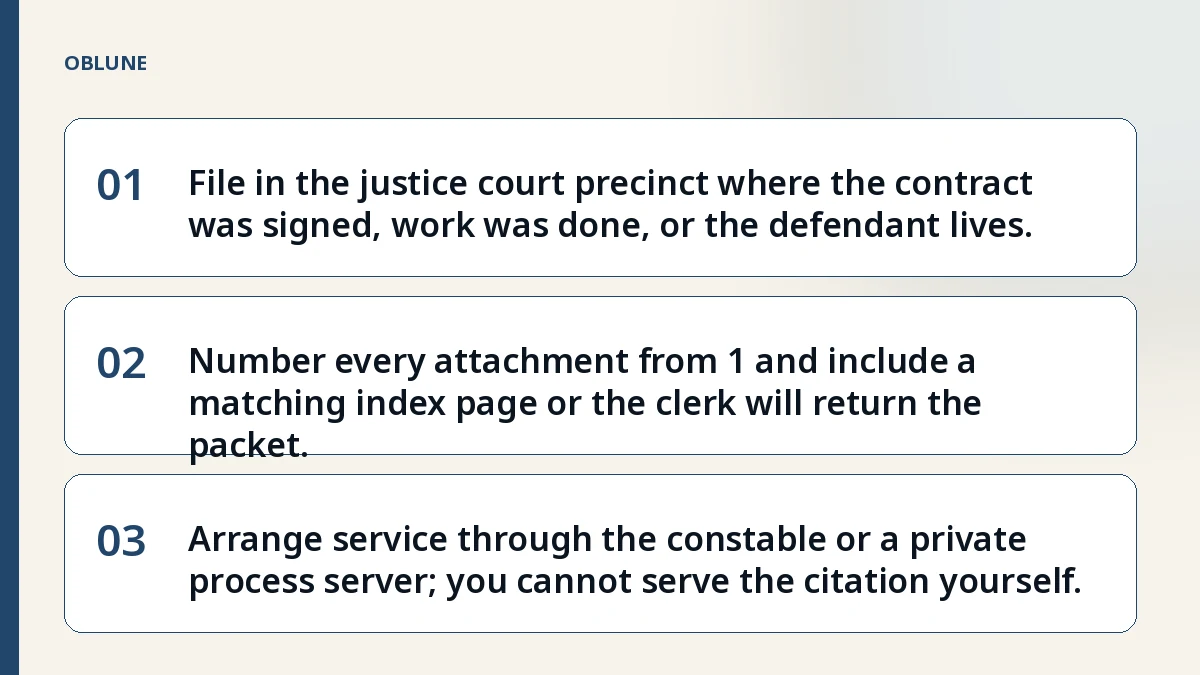
- 01File in the justice court precinct where the contract was signed, work was done, or the defendant lives.
- 02Number every attachment from 1 and include a matching index page or the clerk will return the packet.
- 03Arrange service through the constable or a private process server; you cannot serve the citation yourself.
A Dallas graphic designer waited 90 days for a $4,200 invoice from a boutique hotel on Lower Greenville. The owner stopped replying to texts, so the designer walked into the justice court for Precinct 3 to file a small claim.
Which Court Handles Your Invoice Claim
Justice court in Texas hears civil claims up to $20,000, not counting interest or court costs. If your unpaid invoice exceeds that limit, you must file in county court at law instead. The venue is usually the precinct where the contract was signed, where the work was done, or where the defendant lives or does business. Filing in the wrong precinct is a common reason the clerk returns the petition. Check the court's current instructions before you drive to the courthouse.
The Petition: Caption and Parties
The first page is the caption. It must show the court name, county, and precinct number at the top. Below that, list your full legal name and street address as the plaintiff, then the defendant's full legal name and street address as the defendant. If the defendant is a business, use the exact name on its formation documents or the name it operates under. A missing address for either party means the constable cannot serve the citation, and the clerk will reject the filing.
Statement of Facts: What to Write
The statement of facts tells the judge what happened in numbered paragraphs. Start with the date you agreed to the work, the scope, and the price. Include the invoice date, the amount due, and the due date. Note every payment received and every demand you made, with dates and methods (email, certified mail, Venmo request). Keep each paragraph to one fact. Do not argue the law; just lay out the timeline. The Texas Rules of Civil Procedure, Rule 45, require plain and concise pleadings.
Attachments and Evidence Index
Every document you rely on becomes an attachment. Number them continuously starting at 1, and include an index page that lists each attachment by number and title. Typical attachments for an unpaid invoice claim:
| Attachment | Description |
|---|---|
| 1 | Signed contract or proposal |
| 2 | Invoice with payment terms |
| 3 | Emails or texts demanding payment |
| 4 | Proof of delivery or completion |
| 5 | Bank record showing no payment received |
If the claim rests on a written contract, attach the pages you are relying on. The clerk will return the packet if the index does not match the pages attached.
Filing Fee and Fee Waiver
The court sets the filing fee; it varies by county and precinct. You pay it when you hand the petition to the clerk. If you cannot afford it, file a completed Statement of Inability to Afford Payment of Court Costs (Rule 145). The clerk will review it and may ask for a hearing. Do not leave the fee line blank; either pay or submit the affidavit.
Service of Process: Getting the Citation Served
After the clerk accepts the petition, the court issues a citation. You must arrange for the constable or a private process server to deliver a copy to the defendant. You cannot serve it yourself. Once service is complete, the server files a return with the court. Every document you file after the petition must include a certificate of service stating the date and manner you delivered a copy to the other side (Rule 21a). Missing this certificate is a top rejection reason.
Checklist Before You Hand It to the Clerk
- One signed original petition with numbered paragraphs and completed caption.
- One copy for each defendant plus one for the court file.
- Filing fee paid or fee-waiver affidavit attached.
- Plaintiff and defendant full names and street addresses in the caption.
- Signature in ink on the signature line with printed name, address, and phone beneath it.
- Certificate of service on any document filed after the petition.
- Attachments numbered continuously from 1 with a matching index page.
- Contract pages attached if the claim relies on a written agreement.
- Cause number left blank; the clerk assigns it.
- Verify the claim amount does not exceed the $20,000 justice court limit.
Common Rejection Reasons to Avoid
- Unsigned petition (Rule 57 requires ink signature)
- No certificate of service on post-petition filings
- Attachment numbers skip or do not match the index
- Caption omits a party's address or court name
- Claim amount exceeds justice court jurisdiction
- Filed in the wrong county or precinct for the events
Rules change, and the court's current instructions control. When in doubt, ask the clerk or review the Texas Rules of Civil Procedure, Rule 502, for justice court procedures.
Related reading
Check the filing format before you file
See what the court in your region asks for, and what a prepared package contains.
Common questions
What if the defendant is an LLC but I only know the trade name?
Search the Texas Secretary of State website for the LLC's legal name and registered agent. Use the legal name in the caption and list the registered agent's address for service. The constable serves the registered agent, not the trade name.
Can I email the petition to the court instead of filing in person?
Most justice courts still require paper filing for the original petition. Some counties accept e-filing through the state system, but you must check the specific precinct's current rules. Call the clerk before you assume electronic filing works.
How long does the defendant have to answer after being served?
In justice court, the defendant typically has 14 days from the date of service to file an answer. The exact deadline appears on the citation. If they do not answer, you can request a default judgment under Rule 502.6.
Do I need a lawyer for a justice court small claim?
Self-representation is allowed and common in justice court. The procedures are designed for people without attorneys. You may hire a lawyer if you want, but it is not required.
Official sources
General information about court filing formalities. Not legal advice, and no attorney-client relationship is created. Filing rules change; check the court's current published instructions before you file.