
















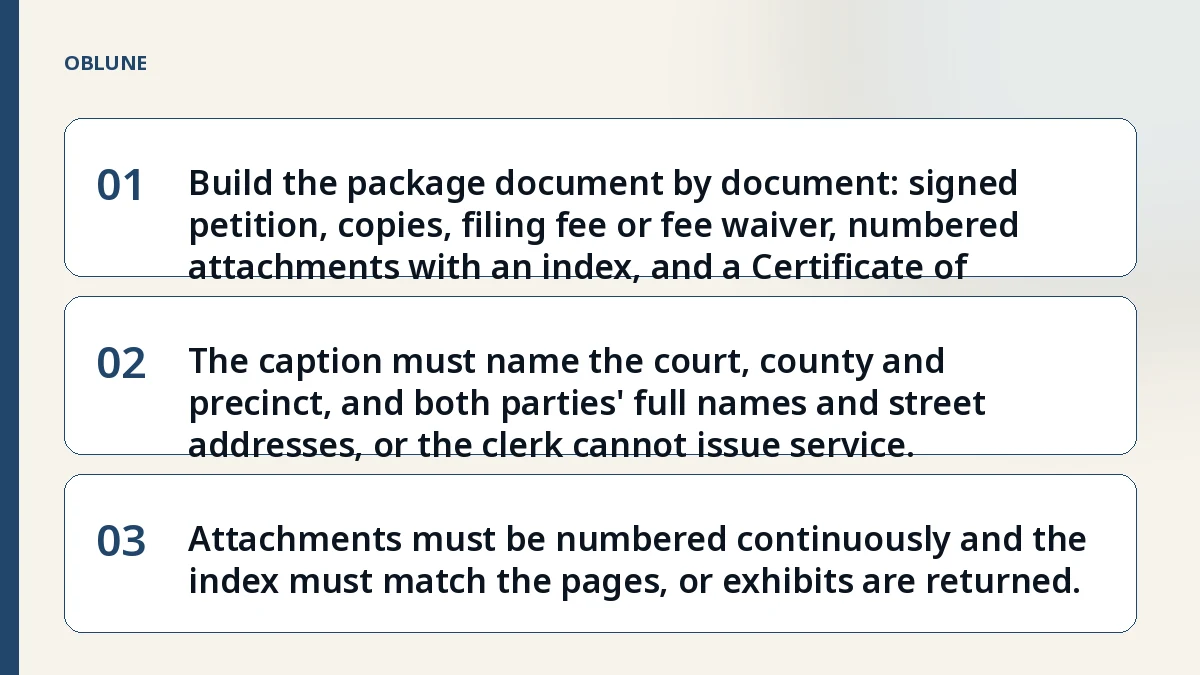
- 01Build the package document by document: signed petition, copies, filing fee or fee waiver, numbered attachments with an index, and a Certificate of Service for later filings.
- 02The caption must name the court, county and precinct, and both parties' full names and street addresses, or the clerk cannot issue service.
- 03Attachments must be numbered continuously and the index must match the pages, or exhibits are returned.
Start with the stack, not the story
A client in Lubbock owes you for three months of bookkeeping. You have the invoices, the emails, and a Venmo request that went ignored. Before you write a single sentence about what happened, build the stack of paper the Justice Court will actually read.
An unpaid invoice small claims court case in Texas is won or lost on packaging. The judge sees the file before the hearing. The clerk sees it first. If the package is incomplete, it gets returned or struck, and you lose weeks.
This is a document-by-document anatomy of a complete claim package for Texas Justice Court, Small Claims, where the limit is generally $20,000 excluding interest and costs. Rules change, and the court's current instructions control.
Document 1: The petition
The petition is the Plaintiff's opening document. In Justice Court it is usually called a petition, and it starts the case. Under the Texas Rules of Civil Procedure, pleadings must be in writing and signed.
Use numbered paragraphs. One fact per paragraph. "Plaintiff provided bookkeeping services to Defendant in March, April, and May 2026. Defendant did not pay Invoice 1043." That is two paragraphs, not one run-on sentence.
The caption at the top must name the court, the county and precinct, the Plaintiff's full name and street address, and the Defendant's full name and street address. If the caption omits a party's address or the court name, the clerk cannot issue service of process.
Sign in ink on the signature line. Print your name, address, and telephone number beneath it. An unsigned pleading is struck. See Texas Rules of Civil Procedure, Rule 45 and Rule 57.
Document 2: The copies and the filing fee
The court needs one signed original petition. It also needs one copy for each Defendant, plus one copy for the court file. If you are suing a company and its owner, that is two Defendants and three copies total.
The filing fee is set by the court. Check the current schedule with the Justice Court clerk before you go. If you cannot afford it, you can file a Statement of Inability to Afford Payment of Court Costs instead. That is governed by Texas Rules of Civil Procedure, Rule 145.
Do not guess the fee. Do not assume a fee waiver is automatic. The clerk's office controls what it accepts.
Document 3: The Attachment index
Attachments are the pages you rely on. They must be numbered continuously from Attachment 1, and they must have an index page listing each attachment by number and name. If the index does not match the pages attached, exhibits are returned.
If the claim rests on a written lease or contract, attach a copy of the pages you are relying on. You do not need the whole contract. You need the pages that prove the deal and the amount owed.
Here is a typical attachment list for an unpaid invoice case:
| Attachment | What it is |
|---|---|
| 1 | Signed contract or engagement letter |
| 2 | Invoice 1043, unpaid |
| 3 | Invoice 1044, unpaid |
| 4 | Email or text where Defendant acknowledges the work |
| 5 | Payment history showing what was and was not paid |
| 6 | Demand letter and proof it was delivered |
Number the pages. If Attachment 3 is three pages, mark them 3-1, 3-2, 3-3. The judge should be able to find any page you mention.
Document 4: The Certificate of Service
Anything you file after the petition needs a Certificate of Service. It states the date and the manner of delivering a copy to the other side. "I certify that on October 26, 2026, I mailed a copy of this document to Defendant at 1400 Main Street, Lubbock, Texas, by first-class mail."
No certificate of service is a common rejection reason. The clerk cannot accept a filing that does not tell the court how the other side got a copy. Rule 21a covers service of notices and documents.
For the petition itself, service of process is handled by the clerk or constable, not by you mailing it. That is a different step. The Certificate of Service is for what you file after the case starts.
Document 5: The Statement of Facts
Keep a one-page Statement of Facts in your own folder. It is not always filed, but it is the page you read from when the judge asks what happened. It should list dates, amounts, and what was done, in order.
The Statement of Facts is your map. It keeps you from rambling. It also helps you check that every fact you plan to say has an attachment behind it.
If a fact has no attachment, decide whether you can prove it another way or whether you should leave it out. A small, tidy case is easier to follow than a large, messy one.
A checklist before you walk in
Use this before you file:
- The petition is signed in ink.
- The caption names the court, county and precinct, and both addresses.
- The stated amount is within the Justice Court limit.
- The county and precinct match where the events happened.
- One original and the correct number of copies are ready.
- The filing fee is paid or the Statement of Inability is completed.
- Attachments are numbered continuously and the index matches.
- A Certificate of Service is attached to anything filed after the petition.
If any line is blank, fix it before you hand the stack to the clerk.
Where people file in the wrong place
Two mistakes send a clean case to the wrong court. The first is filing in the wrong county or precinct for the place where the events happened. The second is stating an amount above the Justice Court limit, which pushes the case to a different court.
County Court at Law is a separate track. Its limits vary by county and by the basis of the claim. Check the county's own limit before filing there.
Self-representation is allowed in Justice Court. You do not need a lawyer to file. You do need to follow the same rules a lawyer would follow.
What happens after filing
Once the petition is filed and service of process is completed, the Defendant has a chance to answer. If the Defendant does not answer, the Plaintiff can ask for a default judgment under Texas Rules of Civil Procedure, Rule 502.6. The court still reviews the paperwork.
Filing is not the finish line. Keep every receipt, every mailing record, and every copy. If the case is continued or reset, you will need them again.
If you are organizing the evidence side of the case, the article on building the evidence file the judge actually reads walks through that step. If you are still deciding whether to file at all, the guided preparation flow can help you sort the documents first.
Check the filing format before you file
See what the court in your region asks for, and what a prepared package contains.
Common questions
How much can I sue for in Texas Justice Court?
Justice court civil jurisdiction generally extends to claims of $20,000 or less, excluding interest and costs. If your invoice total is above that, you may need a different court. Check the current limit with the clerk.
Do I need a lawyer to sue over an unpaid invoice?
No. Self-representation is allowed in Justice Court. You still have to follow the filing rules, including signing the petition and serving copies on the other side.
What if I cannot afford the filing fee?
You can file a Statement of Inability to Afford Payment of Court Costs instead of paying. Rule 145 covers this. The clerk's office will tell you what it requires.
What is the most common reason a petition gets rejected?
An unsigned petition is struck, and a missing Certificate of Service is a common rejection reason. Attachments that are not numbered continuously are also returned. Fix these before you file.
Official sources
General information about court filing formalities. Not legal advice, and no attorney-client relationship is created. Filing rules change; check the court's current published instructions before you file.