
















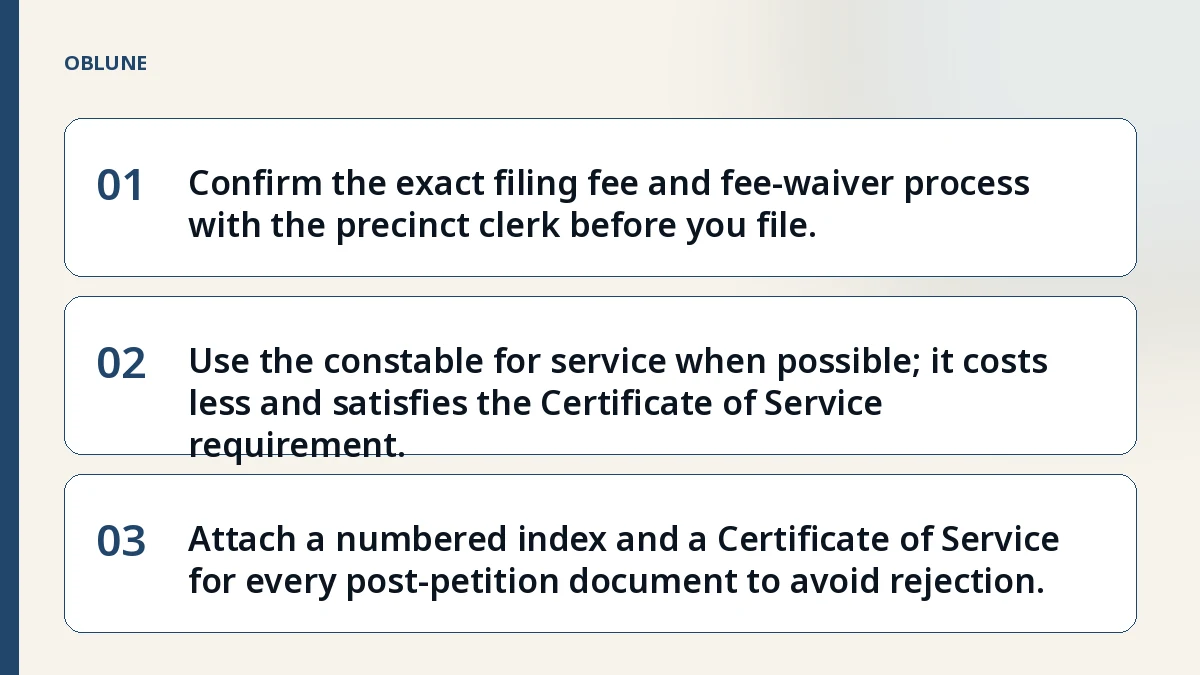
- 01Confirm the exact filing fee and fee‑waiver process with the precinct clerk before you file.
- 02Use the constable for service when possible; it costs less and satisfies the Certificate of Service requirement.
- 03Attach a numbered index and a Certificate of Service for every post‑petition document to avoid rejection.
What the Clerk Expects on Day One
You walk into the justice court with a stack of papers and a check for the filing fee. The clerk will first verify the caption includes the court name, county, precinct, your full name and street address, and the defendant’s full name and street address. If any of those fields are blank, the petition is returned before a cause number is assigned. A signed original petition with numbered paragraphs and a completed Statement of Facts must be on paper; electronic filing is not accepted in most precincts. Rules change, so confirm the current requirements on the court’s website or by calling the clerk.
Filing Fee and Waiver Options
The court sets the fee for a new small‑claims petition, and it varies by county. If you cannot afford it, you may submit a Statement of Inability to Afford Payment of Court Costs (often called a pauper’s affidavit) under Texas Rules of Civil Procedure, Rule 145. The clerk will review the affidavit and either waive the fee or set a reduced amount. Keep a copy of the approved waiver; you will need to attach it to the petition when you file.
Service of Process: Constable vs. Private Process Server
After the petition is accepted, you must arrange service of process on the defendant. Most precincts allow the county constable to serve the citation for a modest fee, which is usually lower than a private process server. If you choose a private server, you must file a Certificate of Service that states the date, method, and name of the person who delivered the papers. Texas Rules of Civil Procedure, Rule 21a governs the acceptable methods and proof of service.
Document Checklist: Attachments, Index, and Certificate of Service
- One signed original petition with numbered paragraphs and a completed Statement of Facts.
- One copy of the petition for each defendant plus one copy for the court file.
- Filing fee payment or approved fee‑waiver affidavit.
- Attachments numbered continuously from 1, with an index page listing each attachment by number and title.
- If your claim rests on a written lease or contract, include the relevant pages as an attachment.
- Certificate of Service for every document filed after the petition, showing date and manner of delivery.
Missing any of these items is a top reason the clerk rejects the filing.
Common Rejection Reasons and How to Fix Them
- Unsigned petition – Sign in ink on the signature line; printed name, address, and phone must appear beneath it (Rule 57).
- No Certificate of Service – Add a certificate for each post‑petition filing.
- Attachments not numbered continuously – Renumber exhibits and update the index before resubmitting.
- Caption missing address or court name – Fill every field; the clerk cannot issue a citation without them.
- Claim exceeds $20,000 limit – File in County Court at Law instead of justice court.
- Wrong county or precinct – Verify venue rules; the suit generally belongs where the transaction occurred or where the defendant resides.
Timeline: From Filing to First Hearing
Once the petition is filed and served, the defendant has 14 days to file an answer. If no answer appears, you may request a default judgment under Rule 502.6. A hearing is typically set within 30 to 45 days after the answer deadline, but the exact date depends on the precinct’s docket. Mark the hearing date on your calendar and prepare a concise evidence binder; the judge will not accept new documents on the day of trial without prior notice.
Quick Cost Summary Table
| Item | Typical Range | Who Pays | Notes |
|---|---|---|---|
| Filing fee | Varies by county | Plaintiff | Check current schedule |
| Constable service | $30–$75 | Plaintiff | Usually cheaper than private server |
| Private process server | $75–$150 | Plaintiff | Must file Certificate of Service |
| Fee‑waiver affidavit | No cost | Plaintiff (if approved) | Submit with petition |
| Copy fees (extra copies) | $1–$2 per page | Plaintiff | Clerk may charge for certified copies |
Budgeting these items upfront prevents surprise expenses and keeps your case moving.
For a guided preparation flow, see the Texas Justice Court preparation tool. If you are pursuing an unpaid invoice, the step‑by‑step guide on filing a small claims case for an unpaid invoice walks through the same checklist. Contractors facing non‑payment can also review the contractor small‑claims guide for evidence tips.
Check the filing format before you file
See what the court in your region asks for, and what a prepared package contains.
Common questions
How much is the filing fee for a Texas justice court small claim?
The fee varies by county; the court sets the amount. Check the current fee schedule on the precinct’s website or call the clerk for the exact dollar amount.
Can I serve the defendant myself?
No. Texas Rules of Civil Procedure, Rule 21a requires service by a constable, sheriff, or authorized private process server. You must file a Certificate of Service showing how and when delivery occurred.
What happens if my petition is rejected for missing attachments?
The clerk will return the filing with a note listing the missing items. Renumber the exhibits, update the index, and resubmit the complete package.
Do I need a lawyer for a justice court small claim?
Self‑representation is allowed and common in justice court. You may hire an attorney, but it is not required.
Official sources
General information about court filing formalities. Not legal advice, and no attorney-client relationship is created. Filing rules change; check the court's current published instructions before you file.