
















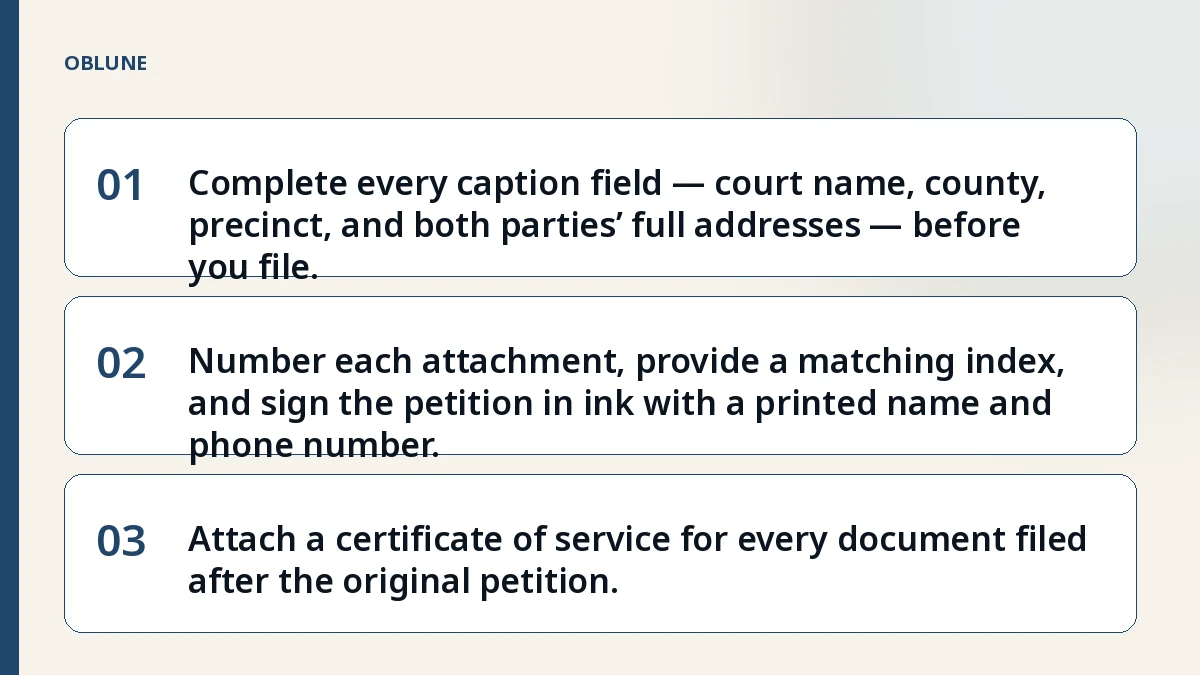
- 01Complete every caption field — court name, county, precinct, and both parties’ full addresses — before you file.
- 02Number each attachment, provide a matching index, and sign the petition in ink with a printed name and phone number.
- 03Attach a certificate of service for every document filed after the original petition.
Start with the caption
When you open a case in a texas justice of the peace small claims court, the first thing the clerk sees is the caption. It must list the court name, the county and precinct, and the full legal names of both parties. If the caption omits an address for either side, the clerk cannot issue service and the filing will be returned. Texas Rules of Civil Procedure, Rule 79 governs the caption format.
Identify the parties and addresses
Write your full name, street address, and phone number as the plaintiff. Do the same for the defendant. Use the exact spelling that appears on any contract, lease, or invoice you are relying on. A missing zip code or a PO Box only for the defendant can delay service because the constable needs a physical location.
State the claim amount and basis
Enter the total amount you are seeking, not including interest or court costs. The justice court limit is $20,000; anything higher belongs in a county court at law. Explain the basis in a short, numbered statement of facts — for example, “1. On March 3, 2026 the defendant received a $4,200 deposit for roof repairs. 2. The work was never started.” Keep each paragraph to one fact.
Attach the supporting documents
If your claim rests on a written lease, contract, or invoice, attach the relevant pages. The court expects the exact clauses you are invoking, not the whole agreement. Label each exhibit as Attachment 1, Attachment 2, and so on. Texas Rules of Civil Procedure, Rule 45 covers pleading form and attachments.
Number your attachments and add an index
Create an index page that lists every attachment by number and title (e.g., “Attachment 1 – Signed roofing contract, pages 1‑3”). The index must match the physical order of the pages. If the numbers skip or the index does not line up, the clerk will return the packet.
Sign the petition and add a certificate of service
Sign in ink on the signature line, then print your name, address, and telephone beneath it. An unsigned pleading is struck under Rule 57. For every document filed after the original petition, include a certificate of service stating the date and method you delivered a copy to the other side (mail, hand delivery, or electronic if agreed). Rule 21a sets the service requirements.
Checklist before you file
- One signed original petition with numbered paragraphs and a complete caption.
- One copy of the petition for each defendant plus one for the court file.
- The filing fee, or a completed Statement of Inability to Afford Payment of Court Costs if you cannot pay.
- All attachments numbered continuously from 1 with a matching index page.
- A certificate of service for any post‑petition filings.
- Verify the claim amount does not exceed the $20,000 justice court limit.
- Confirm you are filing in the correct county and precinct where the dispute arose.
Common rejection reasons to avoid
| Reason | What the clerk looks for |
|---|---|
| Unsigned petition | Signature in ink with printed name, address, phone |
| Missing certificate of service | Date and manner of delivery for every later filing |
| Attachments not numbered continuously | Index matches each attached page |
| Caption omits address or court name | Complete caption per Rule 79 |
| Claim exceeds $20,000 limit | Amount stated within justice court jurisdiction |
| Wrong county or precinct | Venue matches where the events occurred |
Rules change and the court’s current instructions control. Always double‑check the latest forms on the Texas Justice Court page or ask the clerk before you submit. For a guided walk‑through, use the guided preparation flow. If you are filing over an unpaid invoice, see the filing an unpaid invoice and step‑by‑step filing for unpaid invoices articles. For a quick look at fees and logistics, review costs and logistics before you file.
Check the filing format before you file
See what the court in your region asks for, and what a prepared package contains.
Common questions
What happens if I forget to sign the petition?
An unsigned pleading is struck under Rule 57, so the clerk will return it and you must refile with a proper signature.
Do I need a certificate of service for the original petition?
No. The certificate of service is required only for documents filed after the petition, such as motions or amended pleadings.
Can I file electronically in justice court?
Most justice courts still require paper filing; check the specific court’s current instructions or the clerk’s website for e‑filing availability.
What if my claim is slightly over $20,000?
You must file in a county court at law because the justice court’s jurisdictional limit is $20,000, excluding interest and costs.
Official sources
General information about court filing formalities. Not legal advice, and no attorney-client relationship is created. Filing rules change; check the court's current published instructions before you file.