
















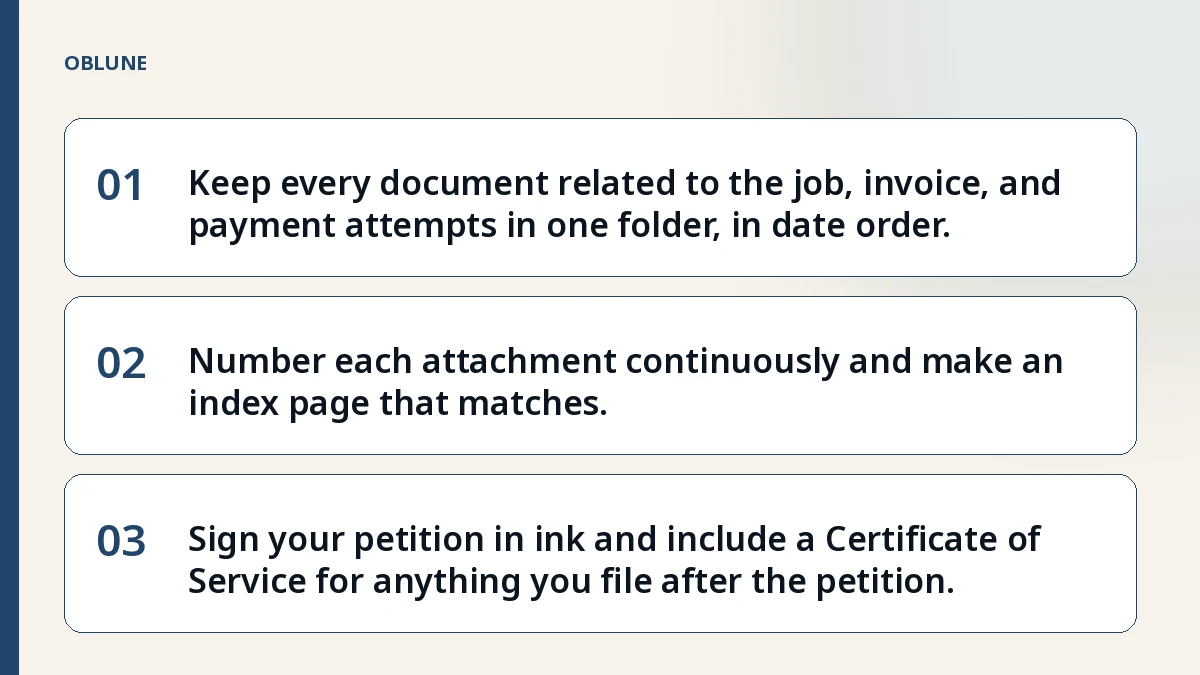
- 01Keep every document related to the job, invoice, and payment attempts in one folder, in date order.
- 02Number each attachment continuously and make an index page that matches.
- 03Sign your petition in ink and include a Certificate of Service for anything you file after the petition.
You finished the job, but the check never came
You painted the fence, fixed the sink, or delivered the goods. The invoice went out on time. The customer said they'd pay. Then the silence. Now you're wondering if you should take the unpaid invoice to small claims court in Texas. Before you file, the smartest thing you can do is build an evidence file that tells your story in order. The clerk and the judge need to see what happened, when it happened, and what you have to prove it.
In Texas, a Justice Court – Small Claims case handles claims up to $20,000, excluding interest and costs. That's where most unpaid invoices land. You can represent yourself. The filing fee is set by the court, and you can ask for a fee waiver if you can't pay. But the real work starts before you walk in the door: organizing your documents.
What the court wants to see
Your petition is the first thing the clerk sees. It needs a caption with the court name, your name and address, and the respondent's name and address. The clerk uses that to issue service of process, so a wrong address can send your case back. Keep your petition on letter-size paper, 1-inch margins, 12-point font, double-spaced, with numbered paragraphs.
But the petition is just the start. The court also looks at your attachments. Every document you rely on must be numbered continuously, starting at 1, with an index page listing each attachment. If you have a written contract or lease, include the pages you're relying on. If you expect a default judgment because the other side won't show up, you'll need a military status affidavit.
The evidence file: what to keep
Your evidence file is a folder, binder, or box with every piece of paper that supports your claim. Think of it as a timeline. Start with the contract or work order. Then add any change orders or extra work approvals. Next come the invoices you sent. Then any emails, texts, or letters about payment. Finally, keep a log of phone calls: who you spoke to, when, and what they said.
Here's a checklist for an unpaid invoice case:
- Contract or written agreement – even a signed estimate helps.
- Invoices – every one, with dates and amounts.
- Proof of delivery or completion – photos, signed receipts, or time logs.
- Payment records – checks, bank statements, or credit card slips showing what was paid.
- Communications – emails, texts, letters, and notes about phone calls.
- Any final demand – a letter asking for payment before you filed.
Keep the originals. Make copies for the court and for the other side. If you have a lot of documents, put them in order by date and label each one with a number. That number goes on your index page.
How to organize your documents
Number your attachments continuously. The first document you mention in your petition is Attachment 1, the second is Attachment 2, and so on. Write the number on the top right corner of each page. Then create an index page that lists each number and the name of the document, like “Attachment 1: Invoice #123, dated March 15.” The court will return attachments if the index doesn't match the pages, so double-check.
When you file, you bring the original petition plus one copy for each defendant, and one copy for the court file. That's a lot of paper, but it's the rule. The clerk will stamp your copies and give you a cause number. Keep that number safe; you'll need it for everything after.
The statement of facts: tell it in order
Your petition includes a Statement of Facts. This is where you describe the events in numbered paragraphs, one event per paragraph, in date order. Start with the job you did. Then the invoice you sent. Then the promise to pay. Then the silence. Use plain language. “I painted the house on June 1 and sent an invoice for $500 on June 15.” That's it. No legal jargon.
For each communication, write a separate paragraph: who contacted whom, when, by what means (phone, email, letter), and what happened. If the customer said “I'll pay next week” but didn't, write that down. The court wants to see the sequence of attempts to resolve the matter.
What to do if you can't pay the filing fee
If you can't afford the filing fee, you can ask the court to waive it. The court uses a form called an Affidavit of Inability to Pay Court Costs. You fill it out, sign it, and file it with your petition. The clerk will tell you if the court needs more information. Don't let the fee stop you from filing if you truly can't pay.
But remember, the fee is just the start. You may also have to pay for service of process, which is how the constable delivers the citation to the other side. The court sets those fees too. Ask the clerk for a current schedule.
Before you file: check the basics
Make sure you're filing in the right county and precinct. The court needs to know where the events happened or where the respondent lives. If you file in the wrong place, the clerk may reject it. Also, check the amount. If your claim is over $20,000, you can't use Justice Court – Small Claims. You'd need a County Court at Law, which has its own limits and rules.
Sign your petition in ink. An unsigned pleading is struck. Include your printed name, address, and phone number under the signature. And for anything you file after the petition, you must include a Certificate of Service – a statement saying when and how you delivered a copy to the other side.
The payoff: a clear case
When your evidence file is organized, filing feels less scary. You know what you havecars, what you're asking for, and why. The clerk can process your paperwork without calling you back. The judge can follow your story. And you can walk out knowing you did your part.
For more on which filing track fits your situation, see our guide on Small Claims Court in Texas: Which Track Fits Your Case. You can also review the preparation flow for step-by-step help, or check the court pages for this jurisdiction. And remember, the court's current instructions always control – rules change, so confirm with the clerk.
Check the filing format before you file
See what the court in your region asks for, and what a prepared package contains.
Common questions
Do I need to attach every document to my petition?
No, but you should attach the ones that support your claim, like the contract and the invoice. The court requires an index page listing each attachment by number and name. If you don't attach a document, you can't rely on it in your statement of facts.
What happens if I don't sign my petition?
The court will strike an unsigned pleading. You must complete the signature block in ink before filing. That's a common rejection reason, so check it twice.
How do I get a military status affidavit?
If you expect a default judgment because the respondent won't appear, you need a military status affidavit. The court provides the form, or you can ask the clerk. It confirms whether the respondent is in the military, which affects the court's ability to enter a default.
Can I file if I can't afford the fee?
Yes. You can file a Statement of Inability to Afford Payment of Court Costs instead of paying the filing fee. The court will review it and decide. The fee amount is set by the court, so ask the clerk for the current schedule.
Official sources
General information about court filing formalities. Not legal advice, and no attorney-client relationship is created. Filing rules change; check the court's current published instructions before you file.